

Most software is built on an unspoken assumption: data lives on disk, and is read from and written to it. The assumption usually holds, until a new way (or need) of storing data appears.
For Qdrant, that happened with serverless mode, where the data sits in object storage instead of on a disk next to the process. This blog tells the story of Universal I/O, the interface we built so that the same code could work in both worlds, and of the design choices that keep the local path cheap. This read is particularly relevant if you are a systems programmer, and some knowledge of Rust will help you follow the code, but the lessons should carry over to many other kinds of software.
To see how deeply that assumption was baked into Qdrant, it helps to look at how we read data before serverless mode: all of our on-disk data structures (vectors, HNSW graphs, and payload indexes) went through mmap, which assumes that an actual disk sits underneath. In serverless mode, however, the data lives in object storage, and the difference in cost is large: a cold mmap read takes about 100 µs on an SSD, whereas the same read over the network takes 10 to 100 ms, which makes it two or three orders of magnitude slower and also exposes it to failure modes that disk reads don’t have.
One option was to re-implement every one of those interactions against object storage, but that would have meant maintaining two versions of the same logic, which tend to drift apart over time, and every data structure would have needed to switch between the two versions, which could change the behavior of the local path that already worked well.
We therefore decided to build a single interface that lets us hot-swap the storage backend underneath the same code, and that work became Universal I/O. In this blog we focus on the read path, since that is where most of our optimizations ended up.
Different Backends, Very Different Costs
mmap is a solid choice for local files because you read the file as a borrowed slice of bytes (&[u8]), the OS keeps hot pages cached in memory, and it loads only the pages you touch. The problem was never performance, but the fact that the implementation was tied to one concrete type, so we could not reuse the same components with any other backend.
What we needed instead was a single abstract interface (a trait, in Rust terms, similar to interfaces in Go and protocols in Python) that standardizes the contract for every backend, rather than a separate concrete implementation for each component. That interface had to cover at least three backends, and they behave very differently from each other:
mmap: synchronous. Very cheap when the data is already in RAM, but a read of cold data blocks on a page fault (around 100 µs on an SSD).io_uring: queued. Many reads can run concurrently, but works only on Linux kernel v5.1 or later (it was introduced in 2019).- Network I/O: asynchronous. Very expensive when the data isn’t cached locally (10 to 100 ms per round trip), and exposed to failure modes that disk reads don’t have.
Neither Async nor Blocking Fits
Because of this gap in cost, the design of the interface seemed to be limited to two approaches, and each with a clear downside:
- Make everything async. This is a great fit for network storage, but a poor fit for
mmapand for data that is already cached, since async isn’t free in Rust: it needs a runtime, and the compiler does a poor job of optimizing async code, which would show up on every read of cached data, possibly affecting existing deployments. - Make everything blocking. This suits the existing
mmapcode, but it is terrible for network requests, which are 100 to 1,000 times slower than disk reads: when each request is sequential and blocks until it finishes, the latency piles up quickly.
After a few iterations, we settled on a middle ground, a ReadPipeline abstraction modeled on io_uring, in which you schedule reads (like pushing to a submission queue) and then wait for results (like reading from a completion queue), while each backend implements the pipeline in the way that suits it best.
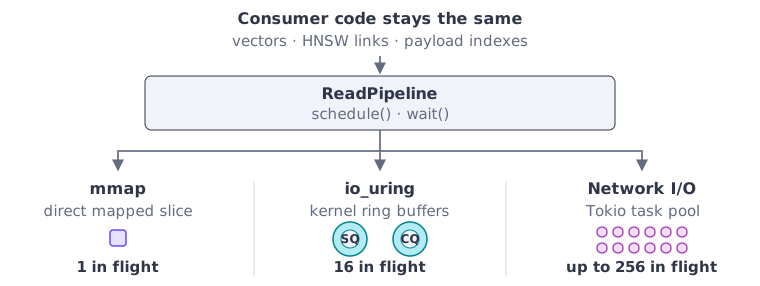
ReadPipeline keeps consumer code unchanged while each backend chooses its own execution model and concurrency.Filesystems, Files, and Pipelines
Universal I/O is built on a set of interdependent Rust traits, and three of them matter for the rest of this blog:
UniversalReadFsis a filesystem handle, which checks whether files exist, lists them, and opens them.UniversalReadis a file handle that does the actual reading. The caller picks the element typeT, such asf32oru32, and passes a hint about the access pattern (sequential or random), and when a backend returns a buffer it allocated itself, it aligns that buffer forT, so the bytes can be cast to a slice ofTwithout copying.ReadPipelineties the other two together: you schedule reads, wait for any of them to finish, and repeat.
Stripped down to the parts this blog uses, the three traits look like this:
trait UniversalReadFs {
    fn open(&self, path, options) -> File;
}
trait UniversalRead {
    fn read<T>(&self, range, access_pattern) -> Cow<[T]>;
}
trait ReadPipeline<UserData> {
    fn can_schedule(&mut self) -> bool;
    fn schedule(&mut self, user_data, file, range);
    fn wait(&mut self) -> Option<(UserData, Cow<[u8]>)>;
}
Reads return a Cow (clone-on-write), a standard library type that holds either borrowed or owned data, so that mmap can stay zero-copy by returning a slice borrowed from the mapped file, while io_uring and the network backend return owned buffers, and the consumer handles both in the same way.
Each backend also chooses its pipeline depth, meaning how many reads can be in flight at once:
mmapuses 1, because it reads as soon as a read is scheduled and therefore behaves synchronously, like the directmmapaccess it replacesio_uringuses 16- the network backend allows up to 256
A full pipeline accepts no more reads until wait() returns a result.
Since reads can finish out of order when the depth is above 1, each request also carries a tag, the user data, which comes back with its result and tells the caller which request it answers. It works like user_data in io_uring, except that it can be any type, and in practice it is often a vector’s position in the batch or a point ID.
The loop at the heart of the default read_batch method shows how these pieces fit together, since it keeps the pipeline as full as the backend allows, takes whichever read finishes first, and hands it to a callback along with its user data:
loop {
    // Fill the pipeline as much as the backend allows
    while pipeline.can_schedule() {
        let Some((user_data, range)) = ranges.next() else { break };
        pipeline.schedule(user_data, file, range);
    }
    // Take whichever read finishes first and hand it to the caller
    let Some((user_data, data)) = pipeline.wait() else { break };
    callback(user_data, data);
}
On mmap, this loop schedules one read, waits for it, and repeats, while on the network backend the same loop keeps up to 256 requests in flight, and the consumer code is identical in both cases.
The two local backends implement this same pipeline: the mmap backend queues nothing, since scheduling a read slices the mapped file and wait() hands the slice back, and its MmapFile type is also what the disk cache uses as the local mirror of a remote file.
The io_uring backend has a queue depth of 16, and it keeps each request’s user data in a slab (a vector of reusable slots) whose key travels with the request as io_uring’s own user_data, so that a completion points back to the caller’s tag.
When the page cache is warm, reads complete almost immediately, so the pipeline holds newly scheduled reads and submits them in a single syscall once it runs out of completed results, instead of making one syscall per read. A file can also be opened with O_DIRECT to bypass the page cache entirely, at the price of aligning every read to 4 KiB.
A Bridge to Async-Land
None of the code described so far uses async Rust, but network reads need it, since a single round trip takes tens of milliseconds and running requests one after another would be far too slow. They have to run concurrently without too much threading overhead, which raises the question of how to keep the pipeline synchronous while the requests complete asynchronously, and we solve it with a bridge in which the pipeline schedules and waits exactly as before, while the async work runs on a dedicated Tokio runtime.
Here is a simplified view of how a read flows through the bridge:
schedulestores the caller’s user data in a slab slot, the same trick theio_uringbackend uses, and spawns the read onto a Tokio worker, which gets its own clone of the reply channel sender to send back the result:fn schedule(&mut self, user_data, file, range) { if self.in_flight == 256 { return Err(QueueIsFull) } let slot = self.slots.insert(user_data); // remember the caller's tag let reply_tx = self.tx.clone(); spawn_on_tokio(async move { // a panic is caught and becomes an error let result = catch_panic(read_from_object_store(file, range)).await; reply_tx.send(Response { slot, result }).await; }); }Because the read runs on another thread,
schedulereturns immediately, and a panic in the task becomes an error reply, so thatwaitnever blocks forever.waitcallsblocking_recvon the pipeline’s receiver, which lets synchronous code receive a response from the async worker, and since each response carries its slot,waitcan reunite the result with the caller’s user data, in the order the requests finish:fn wait(&mut self) { if self.slots.is_empty() { return None } // Block until a worker replies. let response = self.rx.blocking_recv(); // Reunite the result with its tag. let user_data = self.slots.remove(response.slot); Some((user_data, response.result)) }
The following diagram shows the whole flow:
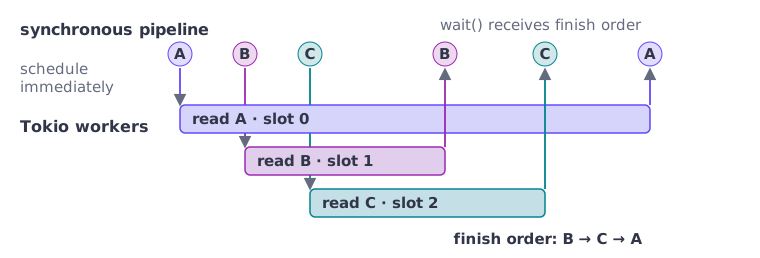
Mirroring Remote Object Storage to Local Disk
Even with the async bridge, a network read is still far slower than a read from memory or local disk, but with a generic I/O interface already in place, we can build a tiered solution on top of it: a backend that caches data by mirroring remote files into local mmap files, which we call DiskCache.
When DiskCache opens a remote file, it creates an empty local file of the same size, logically split into 16 KiB blocks, and it keeps a RoaringBitmap (a compressed bitmap) that records which blocks are already local.
This design relies on one guarantee, which is that in serverless mode the files Qdrant stores in object storage are immutable or append-only, so a remote file can grow but its existing bytes never change. As a result, a fetched block never goes stale, which means that we don’t have to track dirty pages or invalidate anything, and if two reads fetch the same block at once, they write identical bytes to the mirror, so it doesn’t matter which one lands last.
A read through DiskCache then goes like this:
- Check the bitmap. If all the blocks the read needs are local, it is a cache hit and we return a slice of the local mmap, but if even one block is missing, we fetch the whole covering block range from the remote.
- On a miss, try to piggyback, or fetch. Sending a request for every miss would waste round trips, so we first check whether another read in the same batch is already fetching blocks that cover ours. For example, if we need blocks 7 to 10 and another read is already fetching blocks 6 to 12, we wait for that request instead of sending our own, and a new request goes out only when no in-flight one covers our whole range.
- Write to the mirror, then read from it. When a remote read returns, we write the bytes into the local mmap, mark the blocks in the bitmap, and return a slice borrowed from the
MmapFileinstead of the remote buffer, so that hits and misses return the same kind of result.
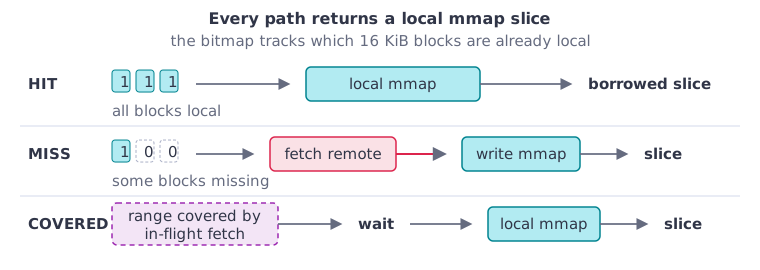
DiskCache path returns a local mmap slice; misses populate the mirror first, and covered reads reuse an in-flight fetch.Put together, the whole flow looks like this, where the real pipeline splits scheduling and waiting into separate calls but follows the same logic:
fn read(range) -> Slice {
    let blocks = blocks_covering(range);

    // 1. Hit: every block is already local (the flag skips the bitmap once all are)
    if self.fully_populated || self.fetched.contains_all(blocks) {
        return self.mirror.slice(range);
    }

    // 2. Miss: piggyback on an in-flight fetch that covers our blocks, or start one
    let fetch = match self.in_flight.find(|f| f.blocks.contains(blocks)) {
        Some(fetch) => fetch,
        None => self.in_flight.start(remote.read(blocks)),
    };

    // 3. Write the fetched bytes to the mirror, mark them, and read from the mirror
    let bytes = fetch.wait();
    self.mirror.write(blocks, bytes);
    self.fetched.insert(blocks);
    self.mirror.slice(range)
}
Once every block is local, the fully_populated flag lets reads skip the bitmap and its lock entirely, and at that point a read is just a slice of the local MmapFile, the same kind of operation the mmap backend performs.
Append-only files can also grow, and reopening one would mean fetching everything again, so DiskCache grows the mirror in two phases: it first stages the change by learning the new remote size and prefetching the new tail, without any visible effect for readers, and then applies it by growing and remapping the local file. This lets Qdrant stage reloads for many files at once and pay only for the slowest one.
The Best of All Worlds (Almost)
Universal I/O started with a narrow question, which was how to read the data structures we already have from storage that isn’t a local disk, and the answer turned out to be less about any single backend and more about finding the right interface between them.
With that interface in place, the storage backend really is hot-swappable: the same search code reads vectors from a local mmap file on a laptop and from S3 in serverless mode, and the local path keeps using mmap. The price on our side was having to create a complex set of interdependent traits to generalize the I/O interface, but we think it is a trade worth making, since every new backend can now plug into Qdrant without touching the data structures that use it.
If you want to see how it fits together, start with the universal_io module in the Qdrant repository and, if you have any questions about it, join our Discord Community and we’ll try to answer there!