
 Module 1
How It Works: Embeddings
What Is an Embedding?
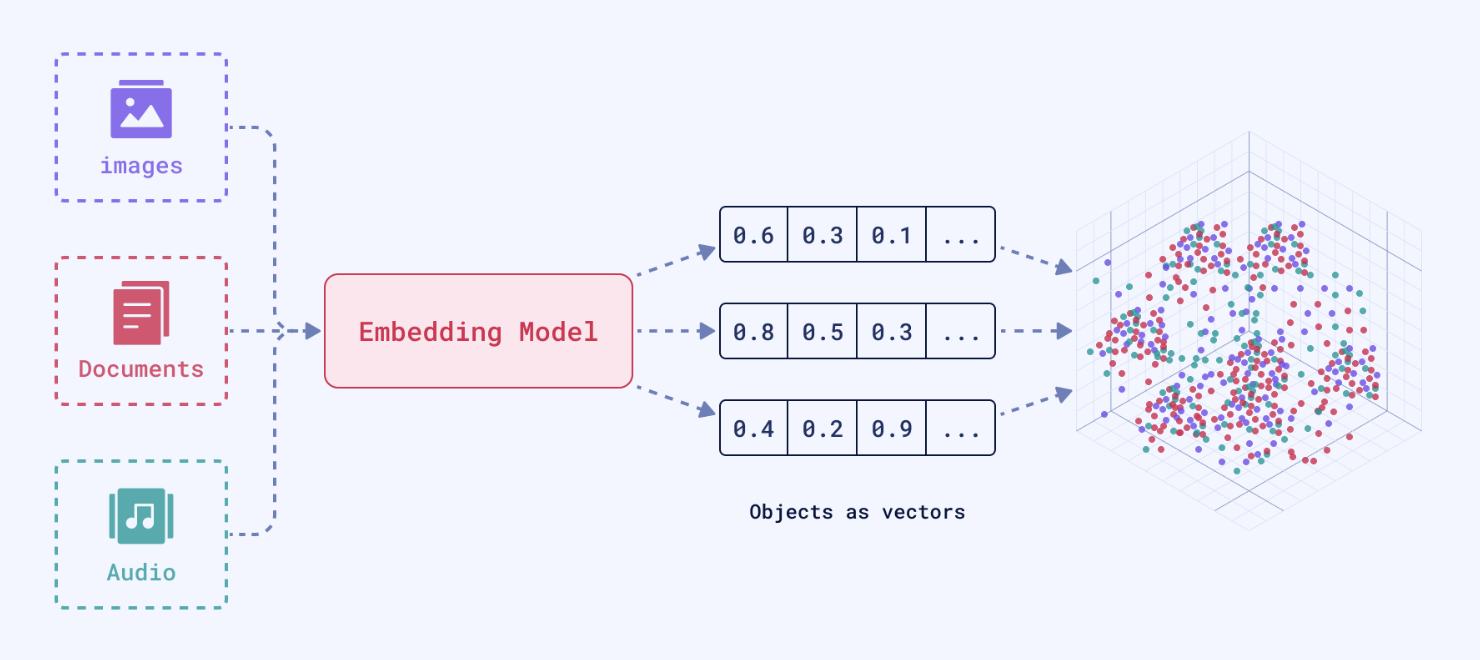
An embedding is a vector: a list of numbers that captures meaning. Semantic search works by converting text into embeddings, text with similar meaning produces embeddings that sit close together in high-dimensional space, and text with different meaning produces embeddings that sit far apart. Each position in that list is a dimension; no single one maps to a human concept like “color,” meaning comes from all of them combined.
The Embedding Model
An embedding model takes a piece of text and returns a fixed-length array of floating-point numbers. The exact numbers matter less than the relationships between them.
from fastembed import TextEmbedding

# model.embed() takes a list of strings and returns one vector per string
model = TextEmbedding(model_name="sentence-transformers/all-MiniLM-L6-v2")
query_vec = list(model.embed(["car repair"]))[0]
doc_vec   = list(model.embed(["automobile maintenance"]))[0]

# check both vectors are the same length (384 dimensions each), then peek at the first 5 floats of each
print(len(query_vec), len(doc_vec))
print(query_vec[:5])
print(doc_vec[:5])
Model Size and Vector Dimension
When choosing an embedding model, two sizes matter:
- Model size is the number of parameters in the model. Larger models often capture more nuance, but need more compute to create embeddings.
- Vector dimension is the number of values in each embedding. Higher-dimensional vectors use more storage and take more work to compare during search.
These are related, but they are not the same. A larger model can produce a short vector, and a higher-dimensional vector does not automatically produce better search results.
Why This Model
This module uses sentence-transformers/all-MiniLM-L6-v2 because it’s small enough to run on a CPU with no API keys or GPU, and accurate enough to demonstrate semantic search clearly. When you start your own project, see Embedding Models for how to weigh size, language, and domain fit when picking a model.