
 Module 2
Fast Approximate Search: HNSW
Searching millions of vectors by computing similarity against every single one (brute force) is slow. Qdrant uses HNSW (Hierarchical Navigable Small World), a graph-based approximate nearest neighbor (ANN) index that makes large-scale search fast at a small, measurable recall cost.
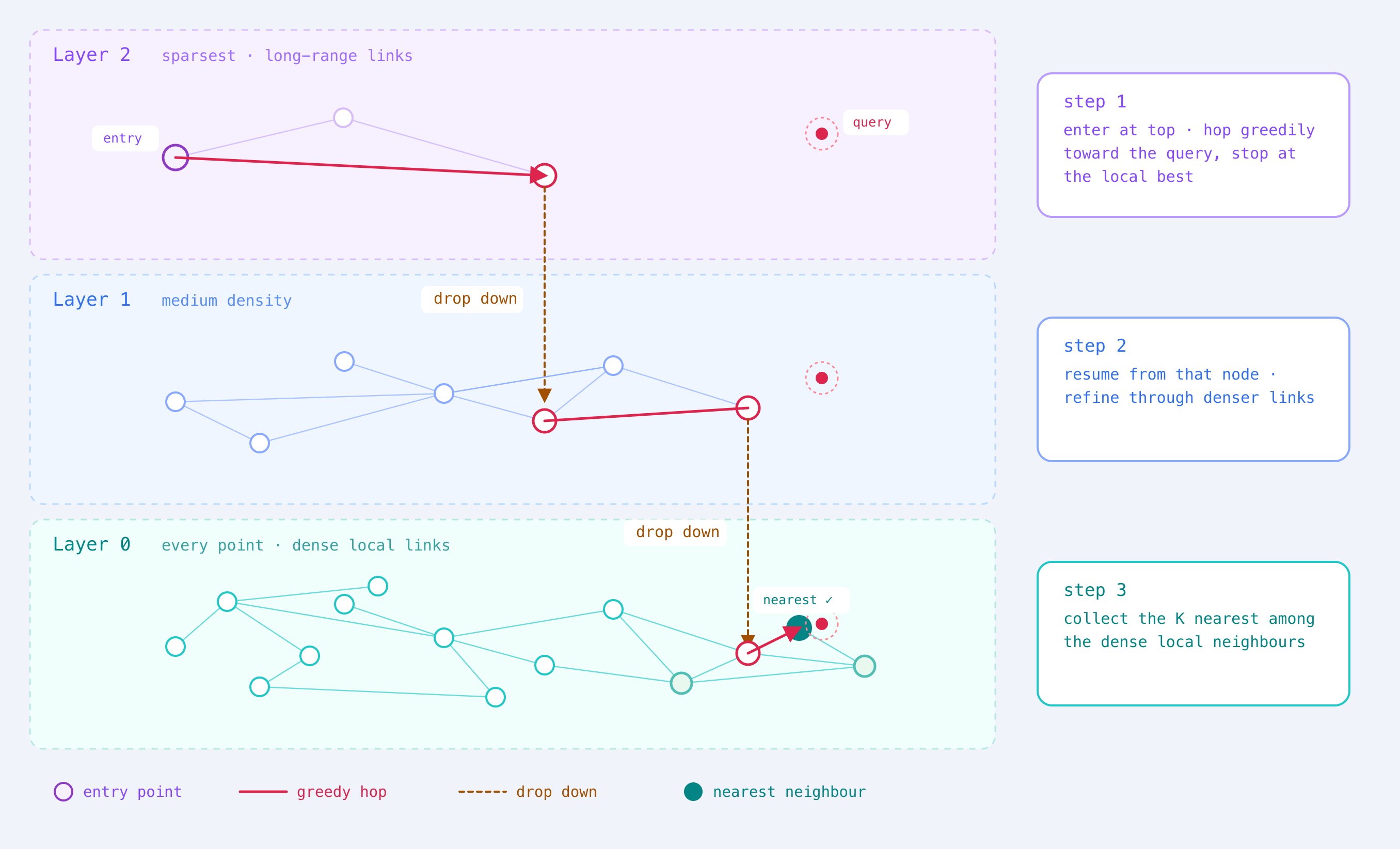
How HNSW Works
- Graph structure: Each vector is a node. Nodes are connected to their nearest neighbors by bidirectional edges, forming a navigable graph.
- Hierarchical layers: The graph has multiple layers. The top layer has few nodes and long-range connections. Lower layers are denser with short-range connections.
- Search by traversal: Query entry starts at the top layer. The search “jumps” through neighbors, zooming in on the region of interest at each layer.
- Approximate, not exact: HNSW trades some recall (see below) for massive speed gains. Whether that trade-off is worth it depends on your data and queries, so measure recall on queries representative of your actual workload rather than assuming it.
Tunable Parameters
HNSW exposes three tunable parameters: m, ef_construct, and hnsw_ef. They balance search speed, recall (the fraction of true nearest neighbors found), memory usage, and indexing time.
Defaults work well for most use cases, so tune them only after benchmarking a real recall or latency gap. This course won’t cover tuning in detail; see the Qdrant Essentials Course when you’re ready.
Real-world queries often combine similarity with metadata filters. Qdrant applies these filters during HNSW traversal instead of searching the full graph and filtering afterward. See Filterable HNSW for details. Payload Filtering covers filtering next.