
 Module 2
Top-K Retrieval
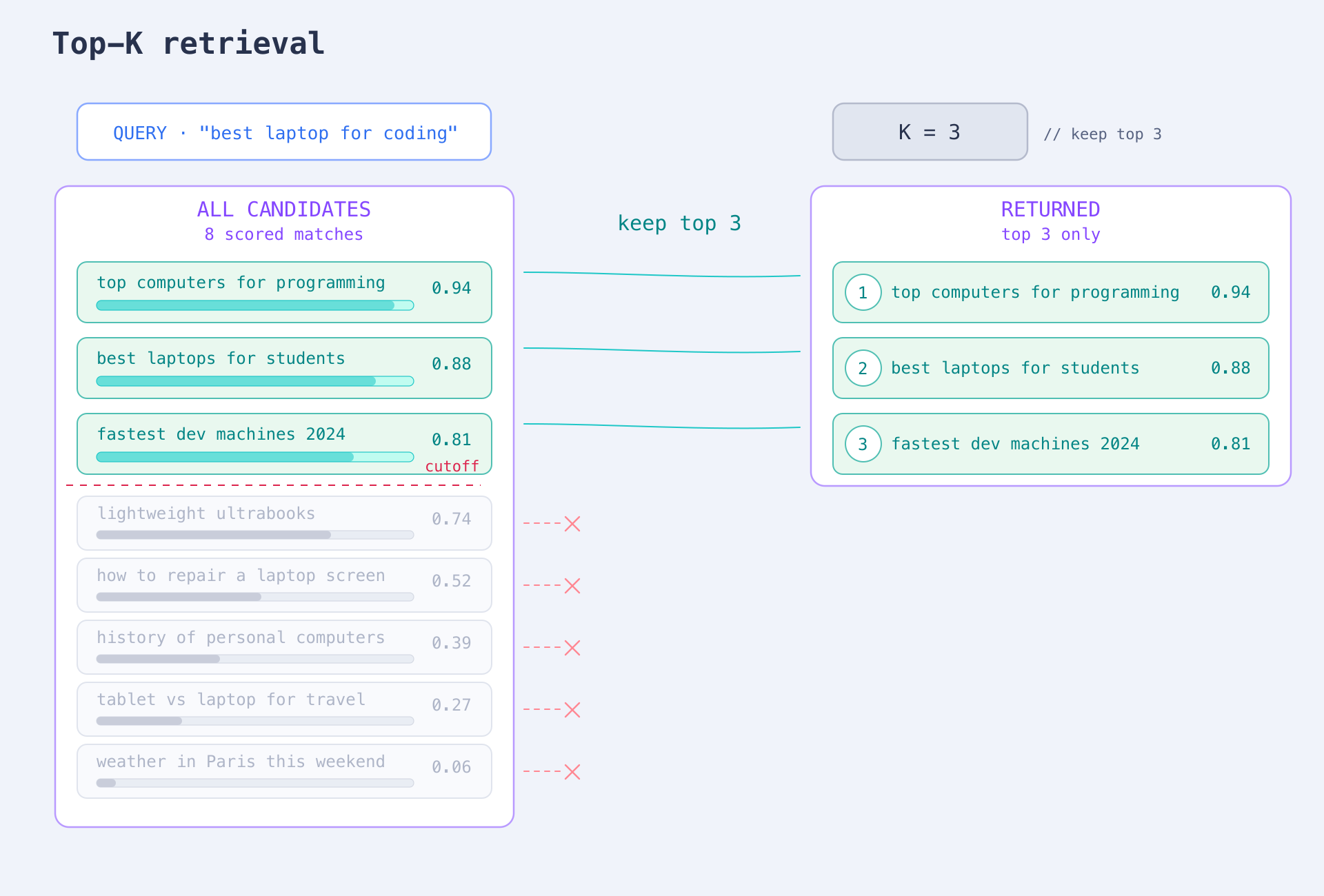
A search query is converted into a vector using the same embedding model used to embed your documents. Qdrant finds the K points in the collection whose vectors are most similar to the query vector, ranked by similarity score.
results = client.query_points(
    collection_name="articles",
    query=[0.12, -0.87, 0.33, ...],   # your query vector
    limit=3,                            # return top 3
)

for r in results.points:
    print(r.id, r.score, r.payload)
Why K Matters
Returning too few results (K=3) misses relevant content. Returning too many (K=100) creates noise in results. A common approach is to overfetch: retrieve a larger candidate pool, then rerank it down to the smaller K you actually show the user. Qdrant supports this natively via multi-stage queries - for example, prefetching a large candidate set and reranking it down to a much smaller final limit. We’ll cover reranking in detail later.