 Module 3
Hybrid Search: Dense and Sparse
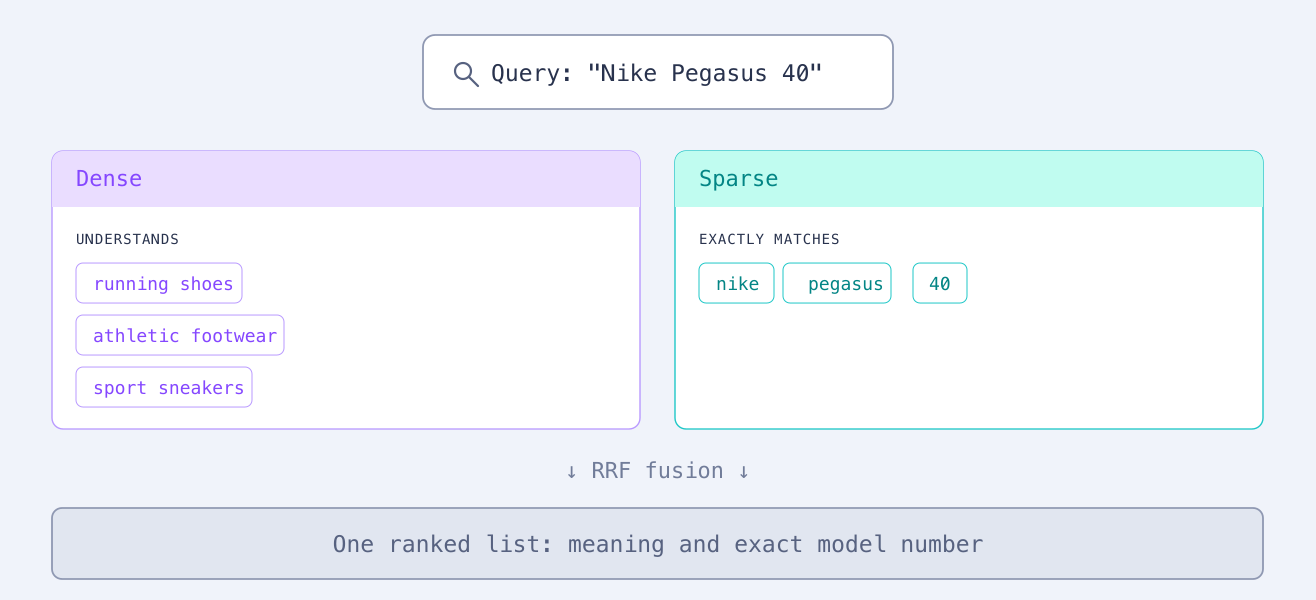
Hybrid search runs both retrievers in the same request and combines their ranked lists into one result set.
Run the same Nike Pegasus 40 query through sparse alone and the picture inverts. The top three:
| Result | Sparse score |
|---|---|
| Nike Pegasus 40 running shoes | 3.8396 |
| Nike Pegasus 40 womens running shoes | 3.8293 |
| Nike Pegasus 41 running shoes | 1.7007 |
Sparse pushes the 41 down to third, because 40 is a different token from 41. But it now has dense’s problem on a different pair: the men’s and women’s Pegasus 40 share every token the query contains, so it separates them by 0.0103 on a 3.8396 top score, roughly a quarter of a percent. Dense had those two 0.09 apart and no trouble at all.
Each retriever ranks the right shoe first, and each leaves it a hair ahead of something wrong. Neither is safe alone.
Fusion
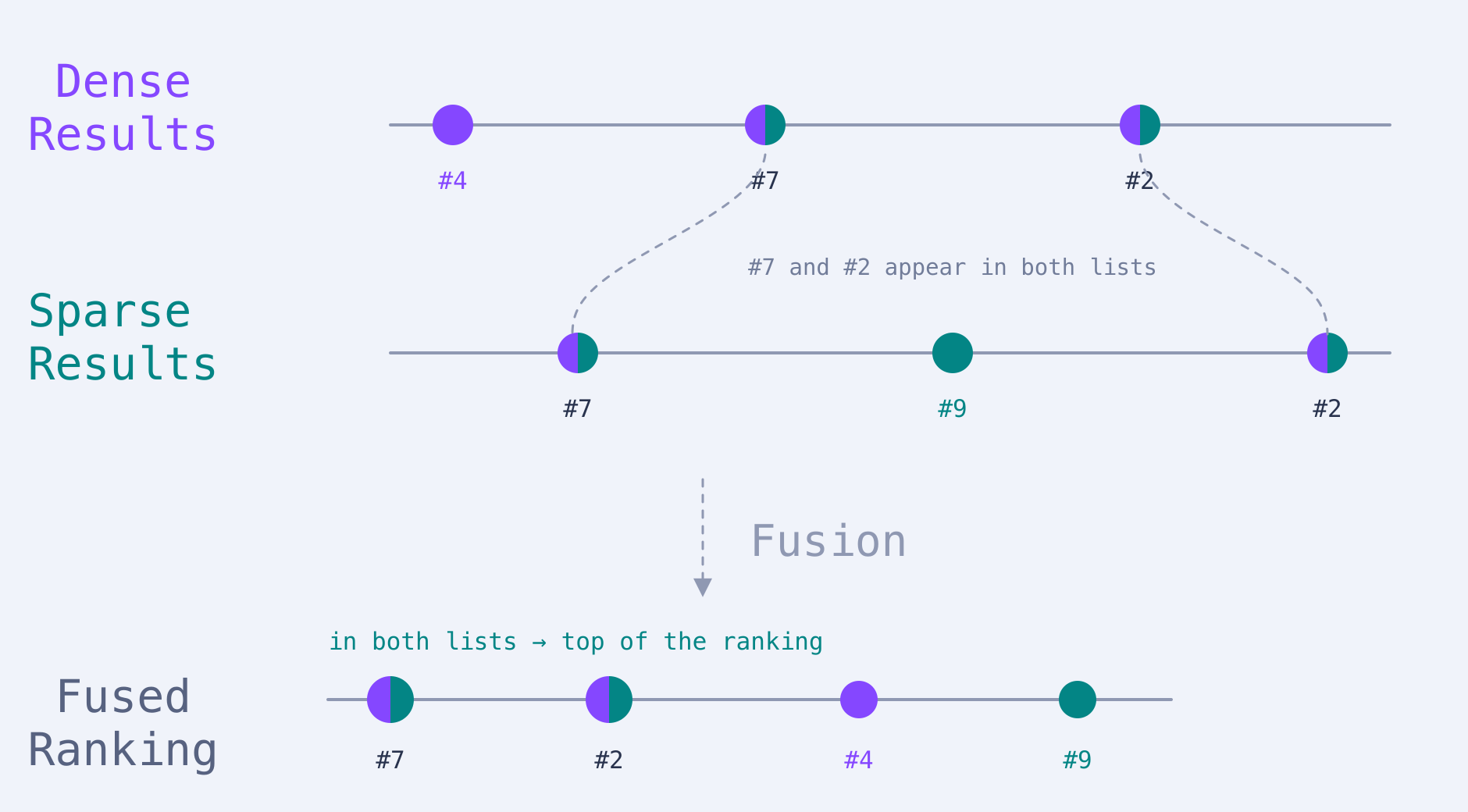
Fusion combines the ranked results from two retrievers into a single list. After both retrievers finish, Qdrant applies fusion on the server to determine the final ranking.
Qdrant supports two fusion strategies: Reciprocal Rank Fusion and Distribution-Based Score Fusion. See the Hybrid Queries documentation for details and available parameters.
Reciprocal Rank Fusion (RRF) is the default. It merges the lists using each candidate’s position and ignores the raw scores entirely, which matters because a dense score of 0.87 and a BM25 score of 3.84 sit on unrelated scales and cannot be meaningfully added. A document ranked highly by both retrievers finishes above one ranked highly by only one.