
 Module 4
Where Design Decisions Live
A vector search system has five layers. The first four go from easiest to hardest to change. Distribution is separate, because its cost depends on which change you make, and Growing Past One Machine covers it.
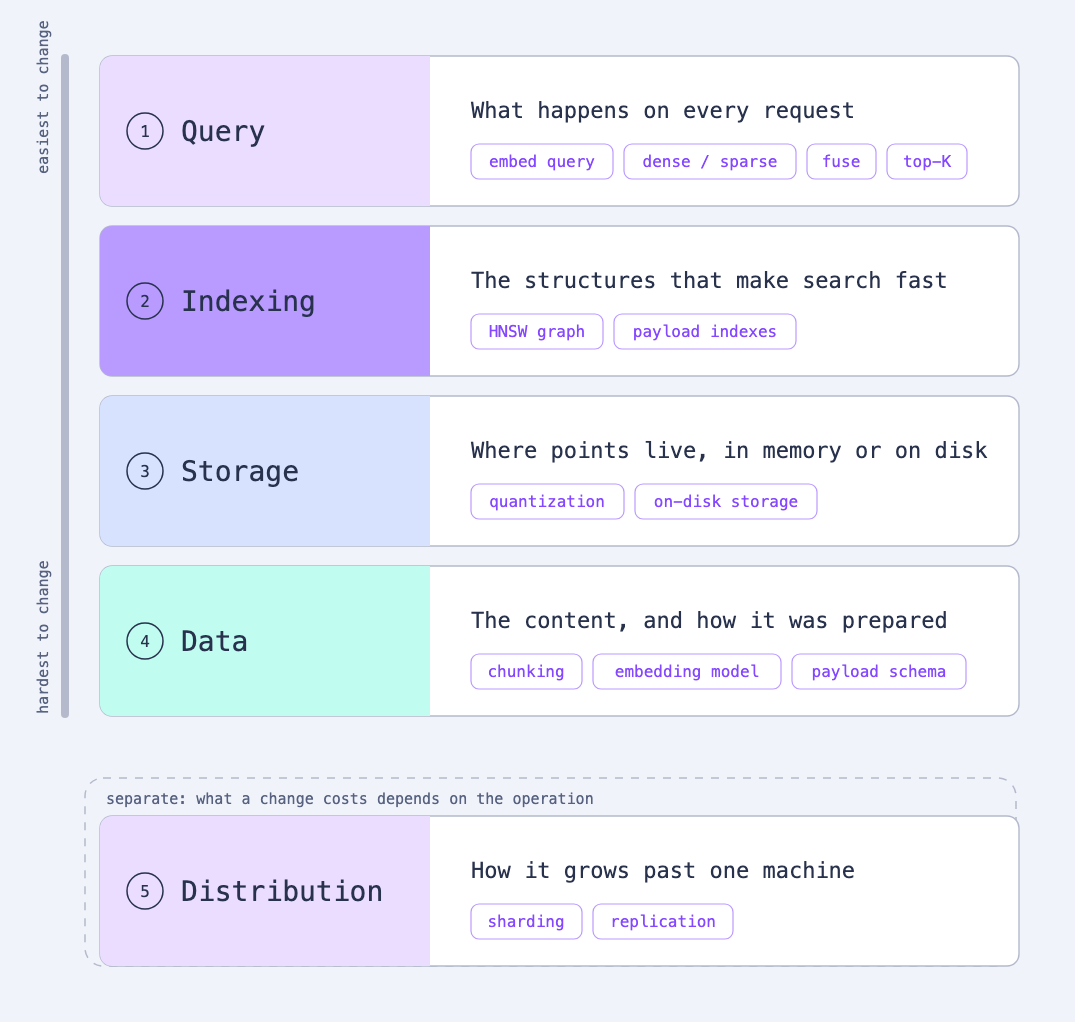
Query handles each request: embed the query, search dense vectors, sparse vectors, or both, then combine the ranked lists into the top-K results. Module 3 covered this layer. If the query is wrong, change it and run it again. The Query API covers every form a query can take.
Indexing contains the structures that make search fast. Qdrant builds two of them: the HNSW graph over your vectors, from Module 2, and a payload index over each field you filter on. A mistake here leaves the results correct and makes them slow, and rebuilding the index fixes it. Indexing covers how to configure both.
Storage controls whether points live in memory or on disk, and therefore how much memory you need. The two main levers are quantization, which compresses each vector into fewer bytes, and on-disk vectors, which keep them in files instead. Both are collection configuration changes, and on an existing collection both rewrite every vector.
Data includes the content and the decisions made before it reaches Qdrant. No layer above can fix a mistake here, so the only fix is ingesting the data again. Decide Before You Ingest works through all four: the text you embed, the model that embeds it, the chunk size, and the payload fields. Vectors and Payload cover what a point can hold.
Distribution spreads a collection across more than one machine, through sharding and replication. Growing Past One Machine covers this layer, and Distributed Deployment has the mechanics.