
 Module 5
System Architecture
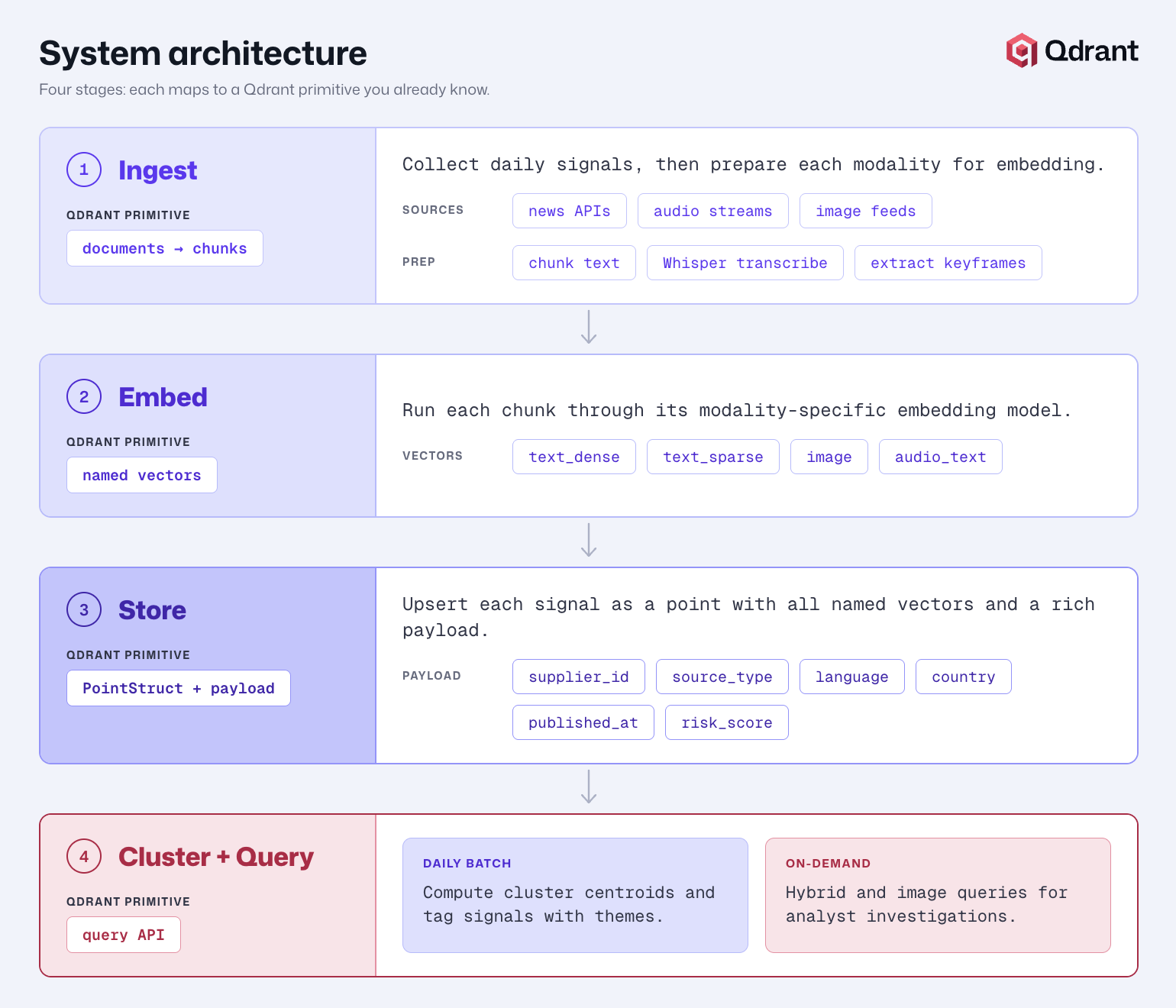
The system has four stages. Each maps to Qdrant primitives you already know.
- Ingest: collect the day’s signals from news APIs, image feeds, and transcript files. Chunk anything longer than a paragraph.
- Embed: hand each part of a signal to the model for its modality, producing named vectors:
text_dense,text_sparse,image. - Store: upsert each signal as one
PointStructcarrying every vector it has, plus a payload: supplier, source type, country, publication date, risk score. - Cluster and Query: a daily batch tags signals with a
cluster_id; on demand, analysts run hybrid and image queries against the same collection.
Collection Schema
One collection holds every modality. Named vectors let you query by text or by image from the same point. Every field an analyst filters on is indexed, exactly as you designed in Module 4.
collection: supplier_signals

named_vectors:
  text_dense:  { model: all-MiniLM-L6-v2, size: 384, distance: Cosine }
  text_sparse: { model: Qdrant/bm25, modifier: IDF }
  image:       { model: Qdrant/clip-ViT-B-32-vision, size: 512, distance: Cosine }

payload_fields:
  supplier_id:  { type: keyword,  indexed: true }
  source_type:  { type: keyword,  indexed: true, values: [news, satellite, audio, filing, social] }
  language:     { type: keyword,  indexed: true }
  country:      { type: keyword,  indexed: true }
  facility_id:  { type: keyword,  indexed: true }
  published_at: { type: datetime, indexed: true }
  risk_score:   { type: float,    indexed: true, range: "0.0 to 1.0" }
  cluster_id:   { type: integer,  indexed: true, note: assigned after ingestion }
  summary:      { type: text,     indexed: false, note: short excerpt or caption }
Three named vectors, not five. A transcript is text once it has been transcribed, and a video frame is an image once it has been sampled, so neither needs a space of its own. Signal Sources and Embedding Models comes back to that.