> Explore Qdrant's agent skills catalog at https://skills.qdrant.tech/
> Search the documentation at https://skills.qdrant.tech/search?query=your+query+here
> Use this file to discover all available pages: https://qdrant.tech/llms.txt
# Build a Food Discovery App with Multimodal Search and Recommendations in Qdrant
| Time: 20 min | Level: Beginner | Output: [GitHub](https://github.com/qdrant/demo-food-discovery/) |
| --- | ----------- | ----------- |
Not every search journey begins with a specific destination in mind. Sometimes, you just want to explore and see what’s out there and what you might like.
This is especially true when it comes to food. You might be craving something sweet, but you don’t know what. You might be also looking for a new dish to try,
and you just want to see the options available. In these cases, it's impossible to express your needs in a textual query, as the thing you are looking for is not
yet defined. Qdrant's semantic search for images is useful when you have a hard time expressing your tastes in words.
## General architecture
We are happy to announce a refreshed version of our [Food Discovery Demo](https://food-discovery.qdrant.tech/). This time available as an open source project,
so you can easily deploy it on your own and play with it. If you prefer to dive into the source code directly, then feel free to check out the [GitHub repository
](https://github.com/qdrant/demo-food-discovery/).
Otherwise, read on to learn more about the demo and how it works!
In general, our application consists of three parts: a [FastAPI](https://fastapi.tiangolo.com/) backend, a [React](https://react.dev/) frontend, and
a [Qdrant](/) instance. The diagram shows how these components interact with each other:
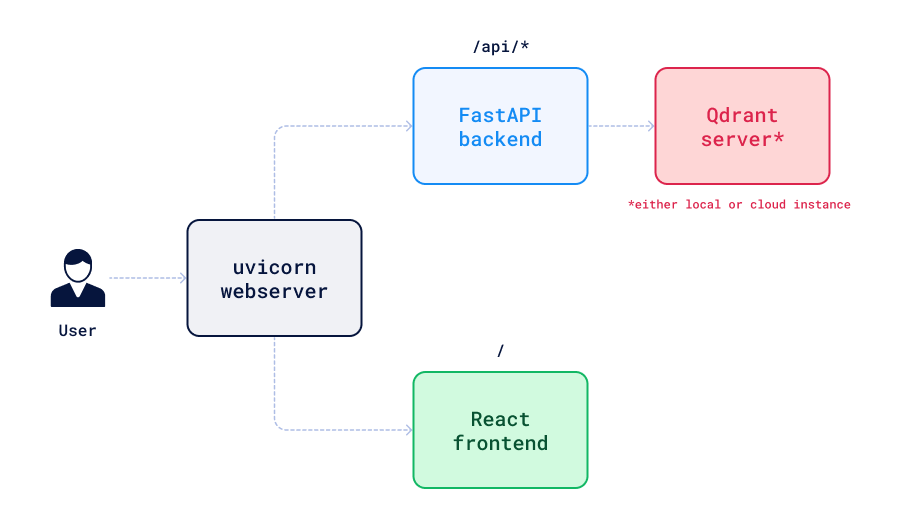
*The demo has three parts behind one uvicorn webserver: a React frontend, a FastAPI backend, and a Qdrant instance, either local or in the cloud. Step through a search to follow a request.*
## Why did we use a CLIP model?
CLIP is a neural network that can be used to encode both images and texts into vectors. And more importantly, both images and texts are vectorized into the same
latent space, so we can compare them directly. This lets you perform semantic search on images using text queries and the other way around. For example, if
you search for “flat bread with toppings”, you will get images of pizza. Or if you search for “pizza”, you will get images of some flat bread with toppings, even
if they were not labeled as “pizza”. This is because CLIP embeddings capture the semantics of the images and texts and can find the similarities between them
no matter the wording.
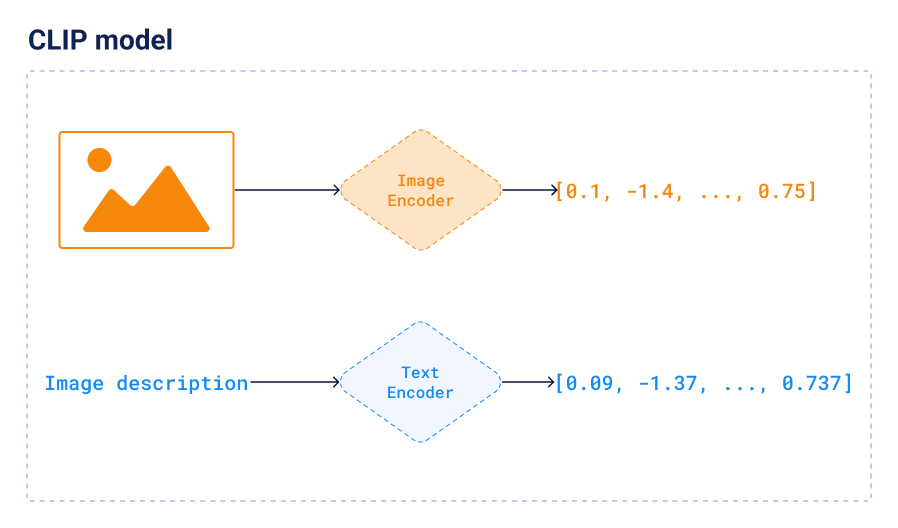
*CLIP encodes an image and a text description with two encoders into vectors of the same space. The vectors shown are shortened examples.*
CLIP is available in many different ways. We used the pretrained `clip-ViT-B-32` model available in the [Sentence-Transformers](https://www.sbert.net/examples/applications/image-search/README.html)
library, as this is the easiest way to get started.
## The dataset
The demo is based on the [Wolt](https://wolt.com/) dataset. It contains over 2M images of dishes from different restaurants along with some additional metadata.
This is how a payload for a single dish looks like (long values are shortened):
```json
{
"cafe": {
"address": "VGX7+6R2 Vecchia Napoli, Valletta",
"categories": ["italian", "pasta", "pizza", "burgers", "mediterranean"],
"location": {"lat": 35.8980154, "lon": 14.5145106},
"menu_id": "610936a4ee8ea7a56f4a372a",
"name": "Vecchia Napoli Is-Suq Tal-Belt",
"rating": 9,
"slug": "vecchia-napoli-skyparks-suq-tal-belt"
},
"description": "Tomato sauce, mozzarella, guanciale, Pecorino Romano, chilli",
"image": "https://wolt-menu-images-cdn.wolt.com/menu-images/.../amatriciana.jpeg",
"name": "L'Amatriciana"
}
```
Processing this amount of records takes some time, so we precomputed the CLIP embeddings, stored them in a Qdrant collection and exported the collection as
a snapshot. You may [download it here](https://storage.googleapis.com/common-datasets-snapshots/wolt-clip-ViT-B-32.snapshot).
## Different search modes
The FastAPI backend [exposes just a single endpoint](https://github.com/qdrant/demo-food-discovery/blob/6b49e11cfbd6412637d527cdd62fe9b9f74ac699/backend/main.py#L37),
however it handles multiple scenarios. Let's dive into them one by one and understand why they are needed.
### Cold start
Recommendation systems struggle with a cold start problem. When a new user joins the system, there is no data about their preferences, so it’s hard to recommend
anything. The same applies to our demo. When you open it, you will see a random selection of dishes, and it changes every time you refresh the page. Internally,
the demo [chooses some random points](https://github.com/qdrant/demo-food-discovery/blob/6b49e11cfbd6412637d527cdd62fe9b9f74ac699/backend/discovery.py#L70) in the
vector space.
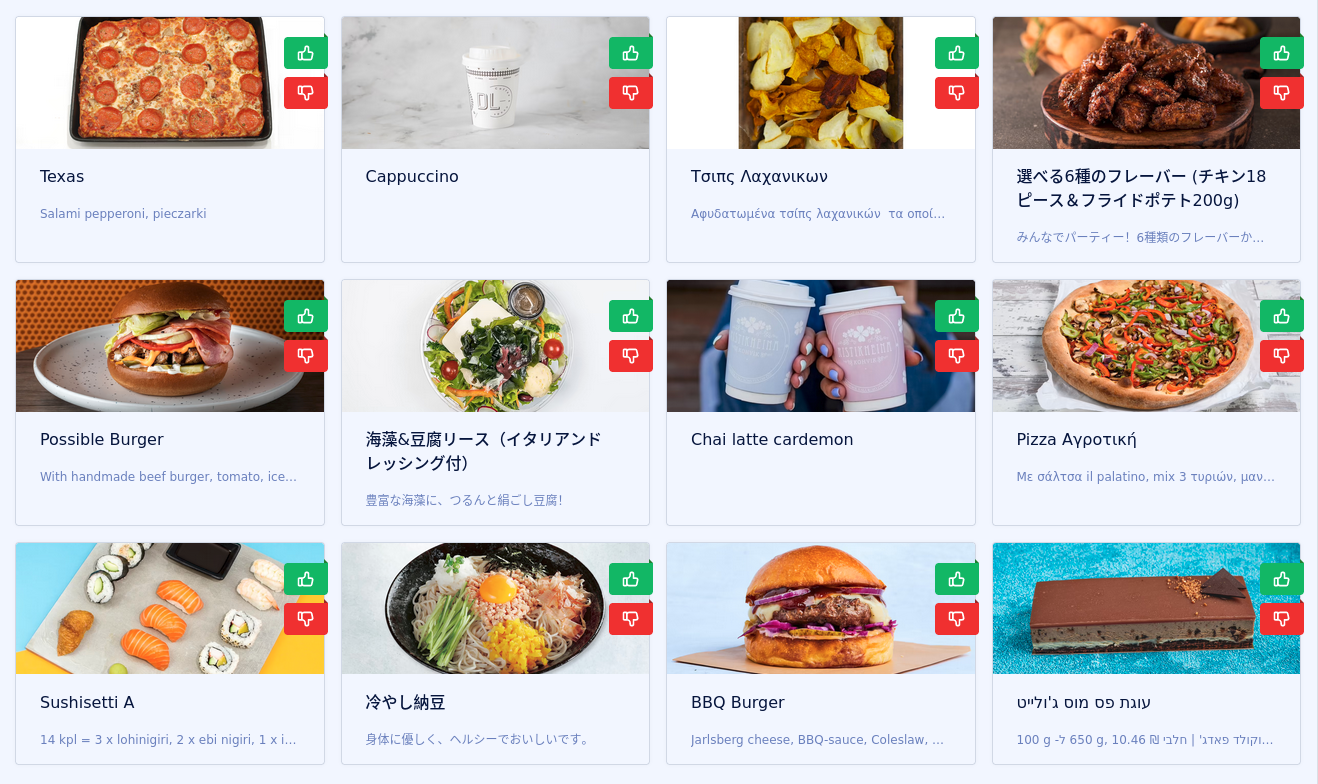
That procedure should result in returning diverse results, so we have a higher chance of showing something interesting to the user.
### Textual search
Since the demo suffers from the cold start problem, we implemented a textual search mode that is useful to start exploring the data. You can type in any text query
by clicking a search icon in the top right corner. The demo will use the CLIP model to encode the query into a vector and then search for the nearest neighbors
in the vector space.
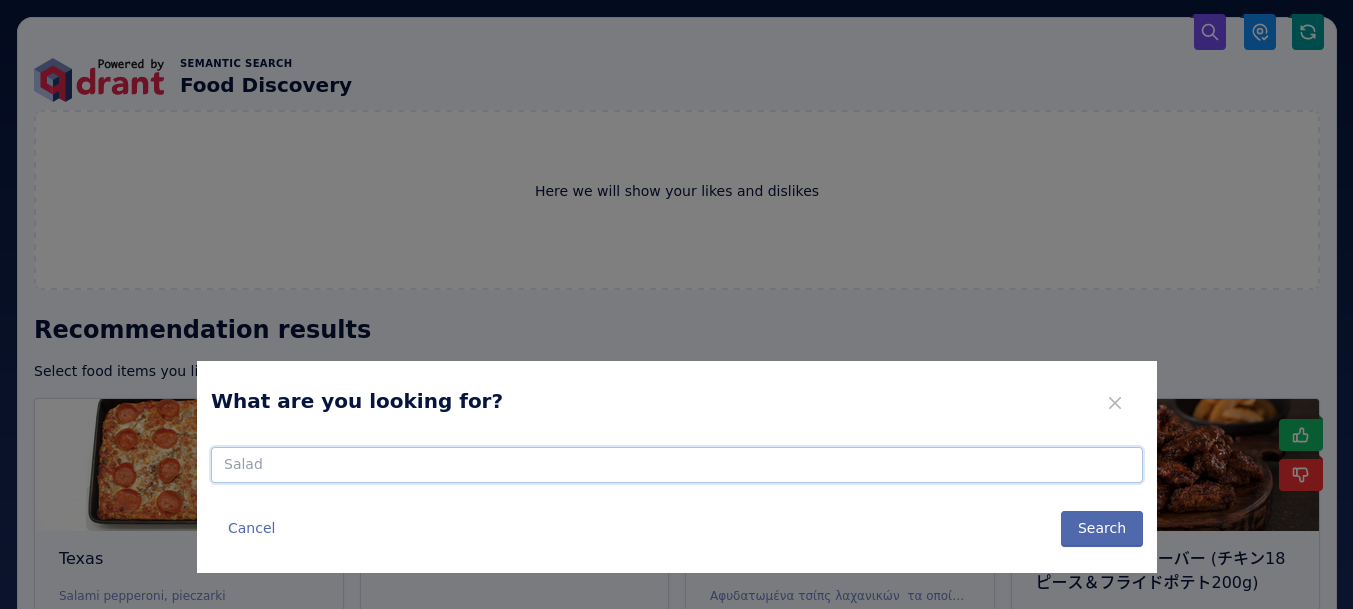
This is implemented as [a group search query to Qdrant](https://github.com/qdrant/demo-food-discovery/blob/6b49e11cfbd6412637d527cdd62fe9b9f74ac699/backend/discovery.py#L44).
We didn't use a simple search, but performed grouping by the restaurant to get more diverse results. [Search groups](https://qdrant.tech/documentation/search/search/index.md#search-groups)
is a mechanism similar to `GROUP BY` clause in SQL, and it's useful when you want to get a specific number of result per group (in our case just one).
```python
import settings
# Encode query into a vector, model is an instance of
# sentence_transformers.SentenceTransformer that loaded CLIP model
query_vector = model.encode(query).tolist()
# Search for nearest neighbors, client is an instance of
# qdrant_client.QdrantClient that has to be initialized before
response = client.query_points_groups(
settings.QDRANT_COLLECTION,
query=query_vector,
group_by=settings.GROUP_BY_FIELD,
group_size=1,
limit=search_query.limit,
)
```
### Exploring the results
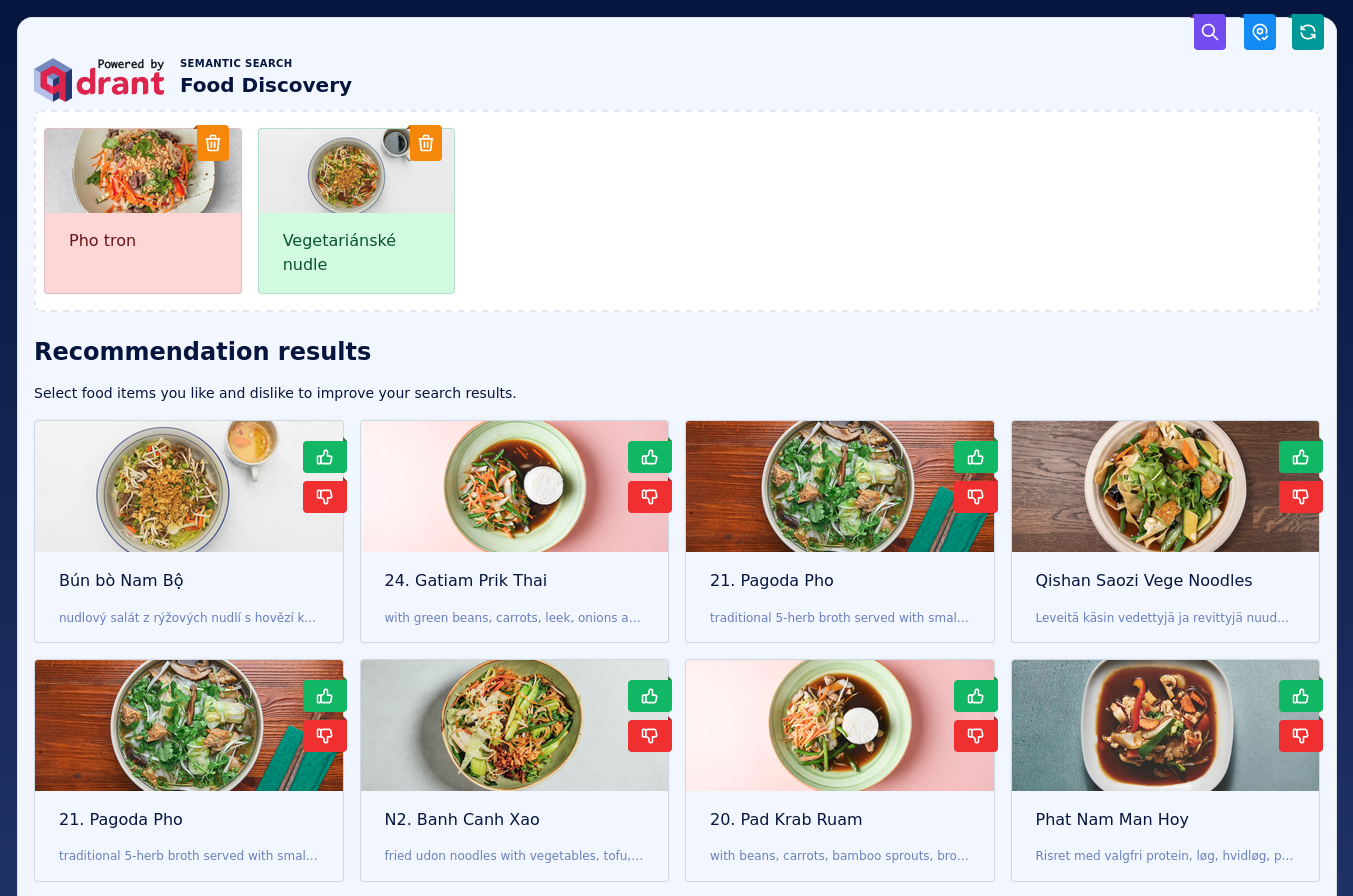
The main feature of the demo is the ability to explore the space of the dishes. You can click on any of them to see more details, but first of all you can like or dislike it,
and the demo will update the search results accordingly.
#### Likes and dislikes
Every like and dislike becomes a positive or a negative example for the [Recommendation API](https://qdrant.tech/documentation/search/explore/index.md#recommendation-api). The demo calls it through the same grouped query as before, with a `RecommendQuery`, so the search happens server-side and the results still come back one per restaurant. [The demo's backend](https://github.com/qdrant/demo-food-discovery/blob/6b49e11cfbd6412637d527cdd62fe9b9f74ac699/backend/discovery.py#L166) makes this call, with the `best_score` strategy as its default. The following is the same request written for the current Python client:
```python
from qdrant_client import models
response = client.query_points_groups(
settings.QDRANT_COLLECTION,
query=models.RecommendQuery(
recommend=models.RecommendInput(
positive=search_query.positive,
negative=search_query.negative,
strategy=models.RecommendStrategy.BEST_SCORE,
)
),
group_by=settings.GROUP_BY_FIELD,
group_size=1,
limit=search_query.limit,
)
```
The examples can be point IDs or raw vectors, and you can mix both in one request. That is how the demo adds textual queries to a recommendation: it embeds the text with CLIP and passes the vector as one more positive example, next to the IDs of the liked dishes.
#### Negative feedback only
With `best_score` you can pass negative examples only, so a user can say "I don't like this dish" without having to like anything first.
```python
response = client.query_points_groups(
settings.QDRANT_COLLECTION,
query=models.RecommendQuery(
recommend=models.RecommendInput(
negative=search_query.negative,
strategy=models.RecommendStrategy.BEST_SCORE,
)
),
group_by=settings.GROUP_BY_FIELD,
group_size=1,
limit=search_query.limit,
)
```
The default `average_vector` strategy still needs at least one positive example. Earlier versions of the demo worked around that by negating the mean vector of the disliked dishes and searching with it, which relies on the angle between a vector and its negation being 180 degrees under cosine distance. The `best_score` strategy makes that workaround unnecessary.
### Choosing a recommendation strategy
The demo lets you switch between two strategies, and the difference shows how each one treats the examples. The [recommendation documentation](https://qdrant.tech/documentation/search/explore/index.md#recommendation-api) covers all strategies, including `sum_scores`.
**`average_vector`** is the default. It averages the positive and the negative examples into a single query vector, with the formula below, and then runs a normal search. It is as fast as a regular search, and it works with point IDs and vectors.
```text
query = avg(positive) + (avg(positive) - avg(negative))
```
**`best_score`** has no single query vector. At every step of the search, it compares a candidate point with each positive and each negative example separately, and keeps the best positive score and the best negative score. If the best positive score is higher, the candidate's score is that value, normalized with a sigmoid. Otherwise, the candidate's score is the negated sigmoid of the best negative score, which pushes the search away from points that are closer to a negative example.
```text
sigmoid(x) = 0.5 * (1 + x / (1 + |x|))
score = sigmoid(best_positive) if best_positive > best_negative
score = -sigmoid(best_negative) otherwise
```
Its cost grows with the number of examples, and its accuracy improves when you raise the `ef` search parameter.
The following observations come from the demo's dataset and CLIP embeddings, which Qdrant 1.6 first made possible. Choosing the right strategy depends on your data, and the embeddings play a significant role, so try both on your own case.
With a single positive example, both strategies return the same results. The difference starts when you add more examples, especially negatives:
The more likes and dislikes you add, the more diverse the results of `best_score` get. With `average_vector` there is just one vector, so all the examples collapse into it, while `best_score` takes every example into account separately:
Passing only negatives can work as an outlier detection mechanism. The dataset was supposed to contain only food photos, but it does not. Passing food photos as negatives returns the most unlike images, which in this dataset are pill bottles and books. `average_vector` returns different results for the same input once it is given a positive example, so each strategy suits different questions:
Multimodality adds a catch. Text queries are far from most of the image embeddings, but close to some of them, so text-to-image search works well. When all query items come from one domain, such as only text, everything works. If you mix a positive text query with negative image examples, the `best_score` results are overwhelmed by the negatives, which are simply closer to the dataset embeddings. In that case, `average_vector` is the better choice:
### Location-based search
Last but not least, location plays an important role in the food discovery process. You are definitely looking for something you can find nearby, not on the other
side of the globe. Therefore, your current location can be toggled as a filtering condition. You can enable it by clicking on “Find near me” icon
in the top right. This way you can find the best pizza in your neighborhood, not in the whole world. Qdrant [geo radius filter](https://qdrant.tech/documentation/search/filtering/index.md#geo-radius) is a perfect choice for this. It lets you
filter the results by distance from a given point.
```python
from qdrant_client import models
# Create a geo radius filter
query_filter = models.Filter(
must=[
models.FieldCondition(
key="cafe.location",
geo_radius=models.GeoRadius(
center=models.GeoPoint(
lon=location.longitude,
lat=location.latitude,
),
radius=location.radius_km * 1000,
),
)
]
)
```
Such a filter needs [a payload index](https://qdrant.tech/documentation/manage-data/indexing/index.md#payload-index) to work efficiently, and it was created on a collection
we used to create the snapshot. When you import it into your instance, the index will be already there.
## Using the demo
The Food Discovery Demo [is available online](https://food-discovery.qdrant.tech/), but if you prefer to run it locally, you can do it with Docker. The
[README](https://github.com/qdrant/demo-food-discovery/blob/main/README.md) describes all the steps more in detail, but here is a quick start:
```bash
git clone git@github.com:qdrant/demo-food-discovery.git
cd demo-food-discovery
# Create .env file based on .env.example
docker-compose up -d
```
The demo will be available at `http://localhost:8001`, but you won't be able to search anything until you [import the snapshot into your Qdrant
instance](https://qdrant.tech/documentation/snapshots/index.md#recover-via-api). If you don't want to bother with hosting a local one, you can use the [Qdrant
Cloud](https://cloud.qdrant.io/) cluster. 4 GB RAM is enough to load all the 2 million entries.
## Fork and reuse
Our demo is completely open-source. Feel free to fork it, update with your own dataset or adapt the application to your use case. Whether you’re looking to understand the mechanics
of semantic search or to have a foundation to build a larger project, this demo can serve as a starting point. Check out the [Food Discovery Demo repository
](https://github.com/qdrant/demo-food-discovery/) to get started. If you have any questions, feel free to reach out [through Discord](https://qdrant.to/discord).