
Deterministic Collection Slicing
| Time: 20 min | Level: Intermediate | Stack: Python | Output: GitHub |  |
|---|
Getting all the points of a large collection with a single call to the Scroll API is slow, and splitting the work across worker processes usually means paging through the collection and dividing IDs by hand.
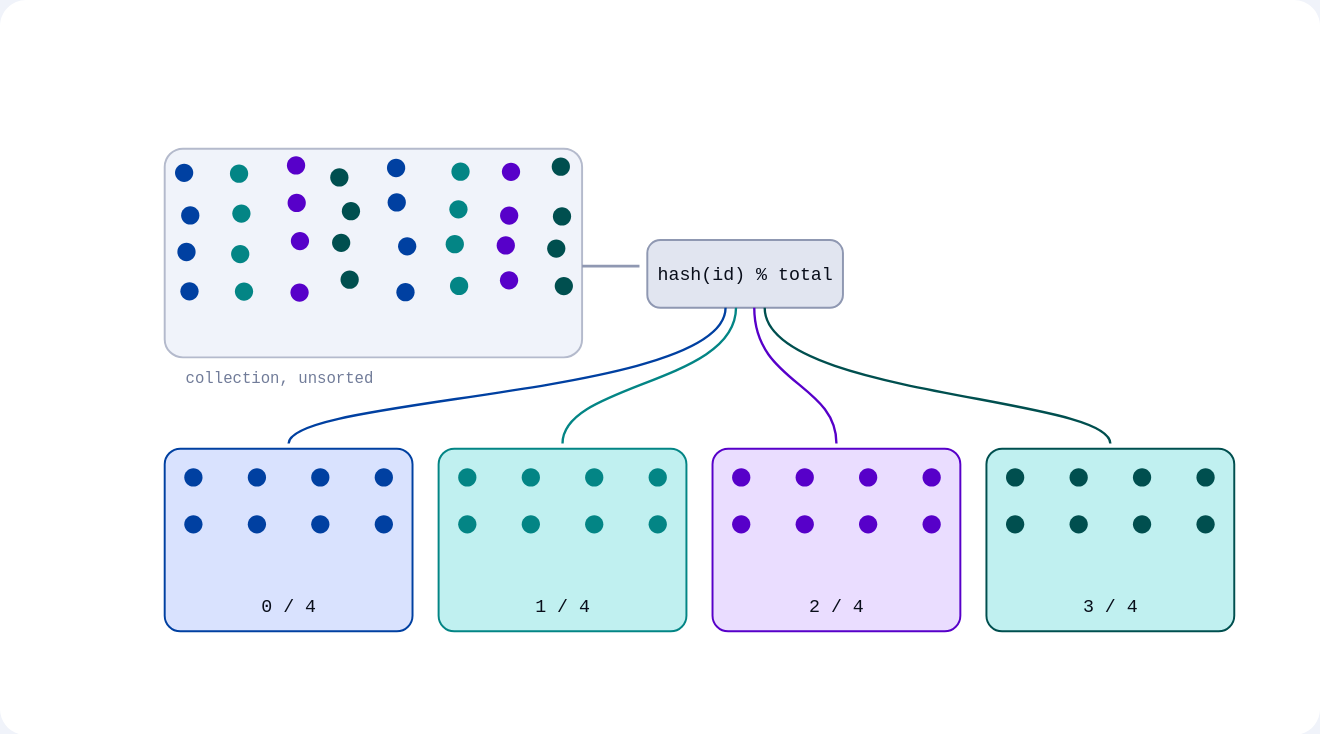
Qdrant’s slice filter condition, available as of v1.19.0, addresses this pain point: it divides a collection into a fixed number of deterministic, disjoint subsets, so a fixed number of workers can each claim one subset with no coordination, and a single subset makes a reproducible sample for evaluation or a train/test split.
Qdrant assigns every point to one slice by hashing its ID. For a fixed total, slices 0 through total - 1 never overlap and together cover the entire collection. Unlike random sampling, the same slice always returns the same set of points. You can also combine slice with any other filter condition, including payload filters. Because slicing is based on the point ID hash rather than payload data, it does not require a payload index. Like has_id, the slice condition is checked against each candidate point within every shard that receives the query.
This tutorial covers three uses: parallel scroll across workers, reproducible sampling for evaluation, and stratified sampling by combining slice with a payload filter.
Setup
We first need to install the Qdrant Python Client:
pip install qdrant-client
While the installation completes, follow the Cloud Quickstart to create a free cluster and retrieve the credentials to connect the client to it. This tutorial uses Qdrant Cloud Inference to embed the sample data server-side, with the free model sentence-transformers/all-MiniLM-L6-v2.
from qdrant_client import AsyncQdrantClient, models

client = AsyncQdrantClient(
    url="https://your-endpoint.cloud.qdrant.io:6333",
    api_key="<paste-your-key>",
    cloud_inference=True,
)

collection_name = "slicing-demo"
embedding_model = "sentence-transformers/all-MiniLM-L6-v2"

await client.create_collection(
    collection_name=collection_name,
    vectors_config=models.VectorParams(size=384, distance=models.Distance.COSINE),
)
Upload a small catalog of product descriptions. Each point’s vector is a Document object, embedded server-side:
import random

random.seed(0)

products = {
    "electronics": [
        "wireless earbuds",
        "4K monitor",
        "mechanical keyboard",
        "USB-C hub",
        "smartwatch",
    ],
    "books": [
        "science fiction novel",
        "cookbook", "history book",
        "graphic novel",
        "poetry collection",
    ],
    "clothing": [
        "running shoes",
        "wool sweater",
        "denim jacket",
        "rain jacket",
        "cotton t-shirt",
    ],
    "home": [
        "cast iron pan",
        "ceramic mug",
        "throw blanket",
        "desk lamp",
        "storage basket",
    ],
}
categories = list(products)

points = []
for i in range(500):
    category = random.choice(categories)
    description = random.choice(products[category])
    points.append(
        models.PointStruct(
            id=i,
            payload={"category": category},
            vector=models.Document(text=description, model=embedding_model),
        )
    )

client.upload_points(collection_name=collection_name, points=points, wait=True)
Scrolling a Single Slice
A SliceCondition takes an index and a total. A single scroll call only returns up to limit points, so to fetch a whole slice you page through it: keep calling scroll with the next_page_offset from the previous response until it comes back None. This pages through slice 3 of 8, one eighth of the collection:
next_page_offset = None
records = []
while True:
    result, next_page_offset = await client.scroll(
        collection_name=collection_name,
        scroll_filter=models.Filter(
            must=[models.SliceCondition(slice=models.Slice(index=3, total=8))],
        ),
        limit=500,
        with_payload=False,
        with_vectors=False,
        offset=next_page_offset,
    )
    records.extend(result)
    if next_page_offset is None:
        break

print(f"slice 3 of 8: {len(records)} points")
# slice 3 of 8: 61 points
With total: 8 and 500 points, each slice holds roughly 60 points, close to 500 / 8.
Concurrent Scrolling Across Workers
The main use case is splitting a full scroll into N independent, non-overlapping scrolls, one per worker. Each worker only needs its own index, and since the slices don’t overlap, the requests have nothing to coordinate on and can run concurrently. Use AsyncQdrantClient with asyncio.gather to fire all requests at once instead of waiting on them one at a time.
import asyncio

async def scroll_slice(index: int, total: int) -> list[models.Record]:
    next_page_offset = None
    records = []
    while True:
        result, next_page_offset = await client.scroll(
            collection_name=collection_name,
            scroll_filter=models.Filter(
                must=[models.SliceCondition(
                    slice=models.Slice(index=index,
                    total=total)
                )],
            ),
            limit=500,
            with_payload=True,
            with_vectors=False,
            offset=next_page_offset,
        )
        records.extend(result)
        if next_page_offset is None:
            break
    return records


total_slices = 10
slices = await asyncio.gather(*(
    scroll_slice(i, total_slices)
    for i in range(total_slices)
))

for i, s in enumerate(slices):
    print(f"worker {i}: {len(s)} points")
print(f"sum across workers: {sum(len(s) for s in slices)}")

# worker 0: 47 points
# worker 1: 56 points
# worker 2: 54 points
# worker 3: 52 points
# worker 4: 41 points
# worker 5: 65 points
# worker 6: 45 points
# worker 7: 45 points
# worker 8: 46 points
# worker 9: 49 points
# sum across workers: 500
Every point appears in exactly one slice, so the counts add up to the full collection with no overlap and no gaps.
Reproducible Sampling
Because the hash is stable across runs and Qdrant versions, a single slice makes a reproducible sample: requesting slice 0 of total: 10 always returns the same 10% of the collection. Random sampling cannot make this guarantee, since it draws a fresh random subset on every call, which is why slice is the right tool for a recall benchmark or a train/test split that has to be repeatable.
A small helper turns a slice into a set of IDs, so the point can be made in a few lines: calling it twice with the same index and total returns the exact same IDs.
async def slice_ids(index: int, total: int) -> set[int]:
    next_page_offset = None
    ids = set()
    while True:
        records, next_page_offset = await client.scroll(
            collection_name=collection_name,
            scroll_filter=models.Filter(
                must=[models.SliceCondition(
                    slice=models.Slice(index=index, total=total)
                )]
            ),
            limit=10000,
            with_payload=False,
            with_vectors=False,
            offset=next_page_offset,
        )
        for p in records:
            ids.add(p.id)
        if next_page_offset is None:
            break
    return ids

first_run = await slice_ids(index=0, total=10)
second_run = await slice_ids(index=0, total=10)

print(f"sample size: {len(first_run)}")
print(f"identical on repeat: {first_run == second_run}")
# sample size: 47
# identical on repeat: True
Slices with different total values are also correlated: slice 0 of total: 4 is always a subset of slice 0 of total: 2. This means you can go from total: 2 to total: 4 to halve your sample, and every point in the smaller sample was already in the bigger one, so nothing you have already evaluated drops out.
Stratified Sampling with Payload Filters
slice is a normal filter condition, so it combines with any other condition. This gives a reproducible sample restricted to one category, useful for a canary rollout or for evaluating a change against a single segment of the data.
await client.create_payload_index(
    collection_name=collection_name,
    field_name="category",
    field_schema=models.PayloadSchemaType.KEYWORD,
)

next_page_offset = None
stratified_results = []

while True:
    stratified, next_page_offset = await client.scroll(
        collection_name=collection_name,
        scroll_filter=models.Filter(
            must=[
                models.SliceCondition(slice=models.Slice(index=0, total=5)),
                models.FieldCondition(
                    key="category",
                    match=models.MatchValue(value="electronics")),
            ],
        ),
        limit=10000,
        with_payload=True,
        with_vectors=False,
        offset=next_page_offset,
    )
    stratified_results.extend(stratified)
    if next_page_offset is None:
        break

print(f"electronics points in slice 0/5: {len(stratified_results)}")
all_match = all(
    p.payload['category'] == 'electronics'
    for p in stratified_results
)
print(f"all match the category: {all_match}")
# electronics points in slice 0/5: 28
# all match the category: True
Related Reading
- Filtering for the full set of filter clauses
slicecombines with. - Scroll Points for paging through a collection.
- Random Sampling for a non-deterministic alternative when reproducibility doesn’t matter.
- Qdrant Cloud Inference for generating the dense embeddings server-side.
 Ready to try Qdrant?