
Data Synchronization Patterns
This page describes patterns for synchronizing data between Qdrant Edge Shards and Qdrant server collections. For a practical end-to-end guide on implementing these patterns, refer to the Qdrant Edge Synchronization Guide.
Initialize Edge Shard from Existing Qdrant Collection
Instead of starting with an empty Edge Shard, you may want to initialize it with pre-existing data from a collection on a Qdrant server. You can achieve this by restoring a snapshot of a shard in the server-side collection.
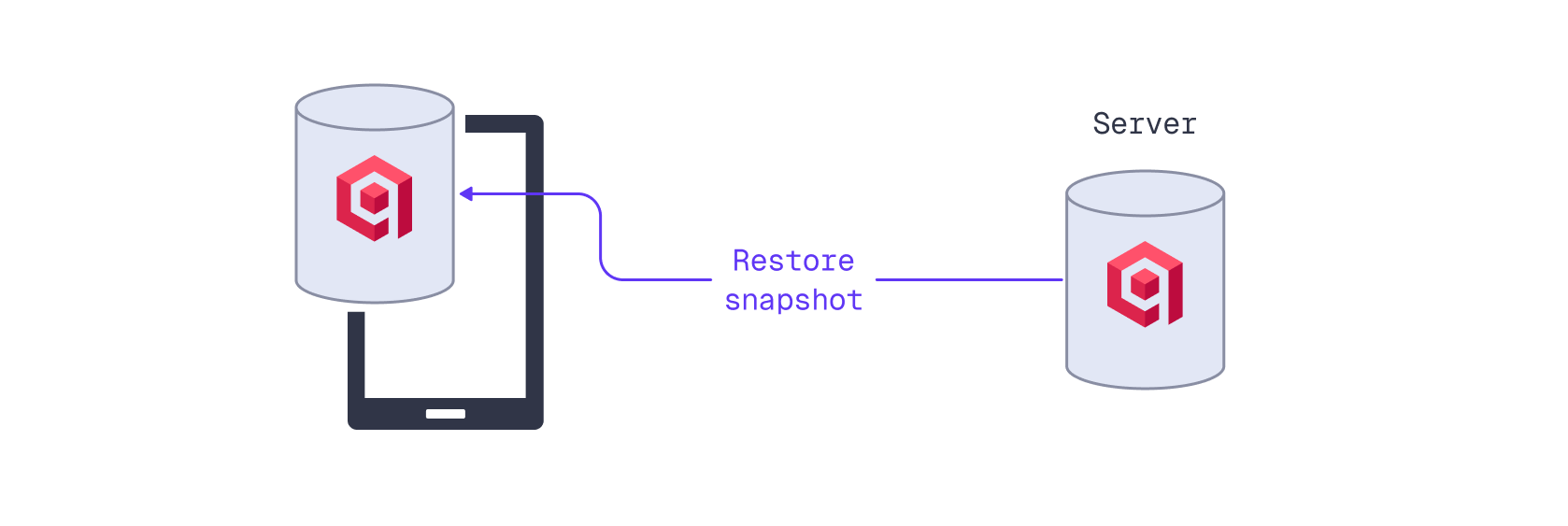
When creating a snapshot for synchronization, specify the applicable server-side shard ID in the snapshot URL. This allows for a single collection to serve multiple independent users or devices, each with its own Edge Shard. Read more about Qdrant’s sharding strategy in the Tiered Multitenancy Documentation.
First, craft a snapshot URL:
COLLECTION_NAME="edge-collection"

snapshot_url = f"{QDRANT_URL}/collections/{COLLECTION_NAME}/shards/0/snapshot"
const COLLECTION_NAME: &str = "edge-collection";

let snapshot_url = format!(
    "{QDRANT_URL}/collections/{COLLECTION_NAME}/shards/0/snapshot"
);
Note that this example uses shard ID 0.
Using the snapshot URL, you can download the snapshot to the local disk and use its data to initialize a new Edge Shard.
from pathlib import Path
from qdrant_edge import EdgeShard
import requests
import shutil
import tempfile

SHARD_DIRECTORY = "./qdrant-edge-directory"
data_dir = Path(SHARD_DIRECTORY)

with tempfile.TemporaryDirectory(dir=data_dir.parent) as restore_dir:
    snapshot_path = Path(restore_dir) / "shard.snapshot"

    with requests.get(snapshot_url, headers={"api-key": QDRANT_API_KEY}, stream=True) as r:
        r.raise_for_status()
        with open(snapshot_path, "wb") as f:
            for chunk in r.iter_content(chunk_size=8192):
                f.write(chunk)

    if data_dir.exists():
        shutil.rmtree(data_dir)
    data_dir.mkdir(parents=True, exist_ok=True)

    EdgeShard.unpack_snapshot(str(snapshot_path), str(data_dir))

edge_shard = EdgeShard.load(SHARD_DIRECTORY)
const SHARD_DIRECTORY: &str = "./qdrant-edge-directory";
let data_dir = Path::new(SHARD_DIRECTORY);

let restore_dir = tempfile::Builder::new()
    .tempdir_in(data_dir.parent().unwrap_or(Path::new(".")))?;
let snapshot_path = restore_dir.path().join("shard.snapshot");

let mut bytes = Vec::new();
std::io::copy(
    &mut ureq::get(&snapshot_url)
        .header("api-key", QDRANT_API_KEY)
        .call()?
        .into_body()
        .into_reader(),
    &mut bytes,
)?;
fs_err::write(&snapshot_path, &bytes)?;

if data_dir.exists() {
    fs_err::remove_dir_all(data_dir)?;
}
fs_err::create_dir_all(data_dir)?;

EdgeShard::unpack_snapshot(&snapshot_path, data_dir)?;

let edge_shard = EdgeShard::load(data_dir, None)?;
This code first downloads the snapshot to a temporary directory. Next, EdgeShard.unpack_snapshot unpacks the downloaded snapshot into the data directory, and an EdgeShard is initialized using the unpacked data and configuration.
The edge_shard will use the same configuration and the same file structure as the source collection from which the snapshot was created, including vector and payload indexes.
Update Qdrant Edge with Server-Side Changes
To keep an Edge Shard updated with new data from a server collection, you can periodically download and apply a snapshot. Restoring a full snapshot every time would create unnecessary overhead. Instead, you can use partial snapshots to restore changes since the last snapshot. A partial snapshot contains only those segments that have changed, based on the Edge Shard’s manifest that describes all its segments and metadata.
manifest = edge_shard.snapshot_manifest()

url = f"{QDRANT_URL}/collections/{COLLECTION_NAME}/shards/0/snapshot/partial/create"

with tempfile.TemporaryDirectory(dir=data_dir) as temp_dir:
    partial_snapshot_path = Path(temp_dir) / "partial.snapshot"
    response = requests.post(url, headers={"api-key": QDRANT_API_KEY}, json=manifest, stream=True)
    response.raise_for_status()

    with open(partial_snapshot_path, "wb") as f:
        for chunk in response.iter_content(chunk_size=8192):
            f.write(chunk)

    edge_shard.update_from_snapshot(str(partial_snapshot_path))
let current_manifest = edge_shard.snapshot_manifest()?;
let update_url = format!(
"{QDRANT_URL}/collections/{COLLECTION_NAME}/shards/0/snapshot\
/partial/create"
);
let temp_dir = tempfile::tempdir_in(data_dir)?;
let partial_snapshot_path = temp_dir.path().join("partial.snapshot");
let mut bytes = Vec::new();
std::io::copy(
&mut ureq::post(&update_url)
.header("api-key", QDRANT_API_KEY)
.send_json(¤t_manifest)?
.into_body()
.into_reader(),
&mut bytes,
)?;
fs_err::write(&partial_snapshot_path, &bytes)?;
let unpacked_dir = tempfile::tempdir_in(data_dir)?;
EdgeShard::unpack_snapshot(&partial_snapshot_path, unpacked_dir.path())?;
let snapshot_manifest = SnapshotManifest::load_from_snapshot(
unpacked_dir.path(),
None,
)?;
let edge_shard = EdgeShard::recover_partial_snapshot(
data_dir,
¤t_manifest,
unpacked_dir.path(),
&snapshot_manifest,
)?;
Update a Server Collection from an Edge Shard
To synchronize data from an Edge Shard to a server collection, implement a dual-write mechanism in your application. When you add or update a point in the Edge Shard, simultaneously store it in a server collection using the Qdrant client.
Instead of writing to the server collection directly, you may want to set up a background job or a message queue that handles the synchronization asynchronously. The application may not always have a stable internet connection, so queuing updates ensures that data is eventually synchronized when connectivity is restored.
First, initialize:
- an Edge Shard from scratch or from server-side snapshot
- a Qdrant server connection.
Details
Initialize an Edge Shard:
from pathlib import Path
from qdrant_edge import (
    Distance,
    EdgeConfig,
    EdgeVectorParams,
)

SHARD_DIRECTORY = "./qdrant-edge-directory"
VECTOR_NAME="my-vector"
VECTOR_DIMENSION=4

Path(SHARD_DIRECTORY).mkdir(parents=True, exist_ok=True)
config = EdgeConfig(
    vectors={
        VECTOR_NAME: EdgeVectorParams(
            size=VECTOR_DIMENSION,
            distance=Distance.Cosine,
        )
    }
)

edge_shard = EdgeShard.create(SHARD_DIRECTORY, config)
const VECTOR_DIMENSION: usize = 4;
const VECTOR_NAME: &str = "my-vector";

fs_err::create_dir_all(SHARD_DIRECTORY)?;
let config = EdgeConfig {
    on_disk_payload: true,
    vectors: HashMap::from([(
        VECTOR_NAME.to_string(),
        EdgeVectorParams {
            size: VECTOR_DIMENSION,
            distance: qdrant_edge::Distance::Cosine,
            on_disk: Some(true),
            quantization_config: None,
            multivector_config: None,
            datatype: None,
            hnsw_config: None,
        },
    )]),
    sparse_vectors: HashMap::new(),
    hnsw_config: Default::default(),
    quantization_config: None,
    optimizers: Default::default(),
};

let edge_shard = EdgeShard::new(
    Path::new(SHARD_DIRECTORY),
    config,
)?;
Initialize a Qdrant client connection to the server and create the target collection if it does not exist:
from qdrant_client import QdrantClient, models

server_client = QdrantClient(url=QDRANT_URL, api_key=QDRANT_API_KEY)

COLLECTION_NAME="edge-collection"

if not server_client.collection_exists(collection_name=COLLECTION_NAME):

    server_client.create_collection(
        collection_name=COLLECTION_NAME,
        vectors_config={VECTOR_NAME: models.VectorParams(size=VECTOR_DIMENSION, distance=models.Distance.COSINE)}
    )
let server_client = Qdrant::from_url(QDRANT_URL)
    .api_key(QDRANT_API_KEY)
    .build()?;

if !server_client.collection_exists(COLLECTION_NAME).await? {
    server_client
        .create_collection(
            CreateCollectionBuilder::new(COLLECTION_NAME).vectors_config(
                VectorParamsBuilder::new(
                    VECTOR_DIMENSION as u64,
                    Distance::Cosine,
                ),
            ),
        )
        .await?;
}
Next, instantiate the queue that will hold the points that need to be synchronized with the server:
from queue import Empty, Queue

# This is in-memory queue
# For production use cases consider persisting changes
upload_queue: Queue[models.PointStruct] = Queue()
// This is an in-memory queue.
// For production use cases consider persisting changes.
let mut upload_queue: std::collections::VecDeque<PointStruct> =
    std::collections::VecDeque::new();
When adding or updating points in the Edge Shard, also enqueue the point for synchronization with the server.
from qdrant_edge import ( Point, UpdateOperation )
from qdrant_client import models

id=1
vector=[0.1, 0.2, 0.3, 0.4]
payload={"color": "red"}

point = Point(
    id=id,
    vector={VECTOR_NAME: vector},
    payload=payload
)

edge_shard.update(UpdateOperation.upsert_points([point]))

rest_point = models.PointStruct(id=id, vector={VECTOR_NAME: vector}, payload=payload)

upload_queue.put(rest_point)
let id = 1u64;
let vector = vec![0.1f32, 0.2, 0.3, 0.4];
let payload = json!({"color": "red"});

let edge_points: Vec<PointStructPersisted> = vec![
    EdgePoint::new(
        PointId::NumId(id),
        Vectors::new_named([(VECTOR_NAME, vector.clone())]),
        payload.clone(),
    )
    .into(),
];
edge_shard.update(UpdateOperation::PointOperation(
    PointOperations::UpsertPoints(
        PointInsertOperations::PointsList(edge_points),
    ),
))?;

let server_point = PointStruct::new(
    id,
    HashMap::from([(VECTOR_NAME.to_string(), vector)]),
    payload.as_object().cloned().unwrap_or_default(),
);
upload_queue.push_back(server_point);
A background worker can process the upload queue and synchronize points with the server collection. This example uploads points in batches of up to 10 points at a time:
BATCH_SIZE = 10
points_to_upload: list[models.PointStruct] = []

while len(points_to_upload) < BATCH_SIZE:
    try:
        points_to_upload.append(upload_queue.get_nowait())
    except Empty:
        break

if points_to_upload:
    server_client.upsert(
        collection_name=COLLECTION_NAME, points=points_to_upload
    )
const BATCH_SIZE: usize = 10;
let points_to_upload: Vec<PointStruct> = upload_queue
    .drain(..BATCH_SIZE.min(upload_queue.len()))
    .collect();

if !points_to_upload.is_empty() {
    server_client
        .upsert_points(UpsertPointsBuilder::new(
            COLLECTION_NAME,
            points_to_upload,
        ))
        .await?;
}
Make sure to properly handle errors and retries in case of network issues or server unavailability.

