
Time-Based Sharding in Qdrant
When working with massive, fast-moving datasets, like social media or image/video streams, efficient storage and retrieval are critical. Often, only the most recent data is relevant, while older data can be archived or deleted. For instance, in sentiment analysis of social media posts, you might only need the last 7 days of data to capture current trends, with most queries focusing on the last 24 hours.
Storing everything in Qdrant collection with default sharding can lead to expensive re-indexing across the entire dataset when deleting old points, impacting performance. A better solution is time-based sharding, where points are routed to a specific shard (or shards) based on timestamp. For use cases with a natural time-to-live (TTL) segmentation, sharding by a timestamp-based key enables efficient querying of recent data and allows users to seamlessly drop the old.
For example, with daily shards, today’s data is stored in today’s shard, yesterday’s data in yesterday’s shard, and so on. Queries can target specific shards (today’s shard, for example) or multiple shards to cover a date range.
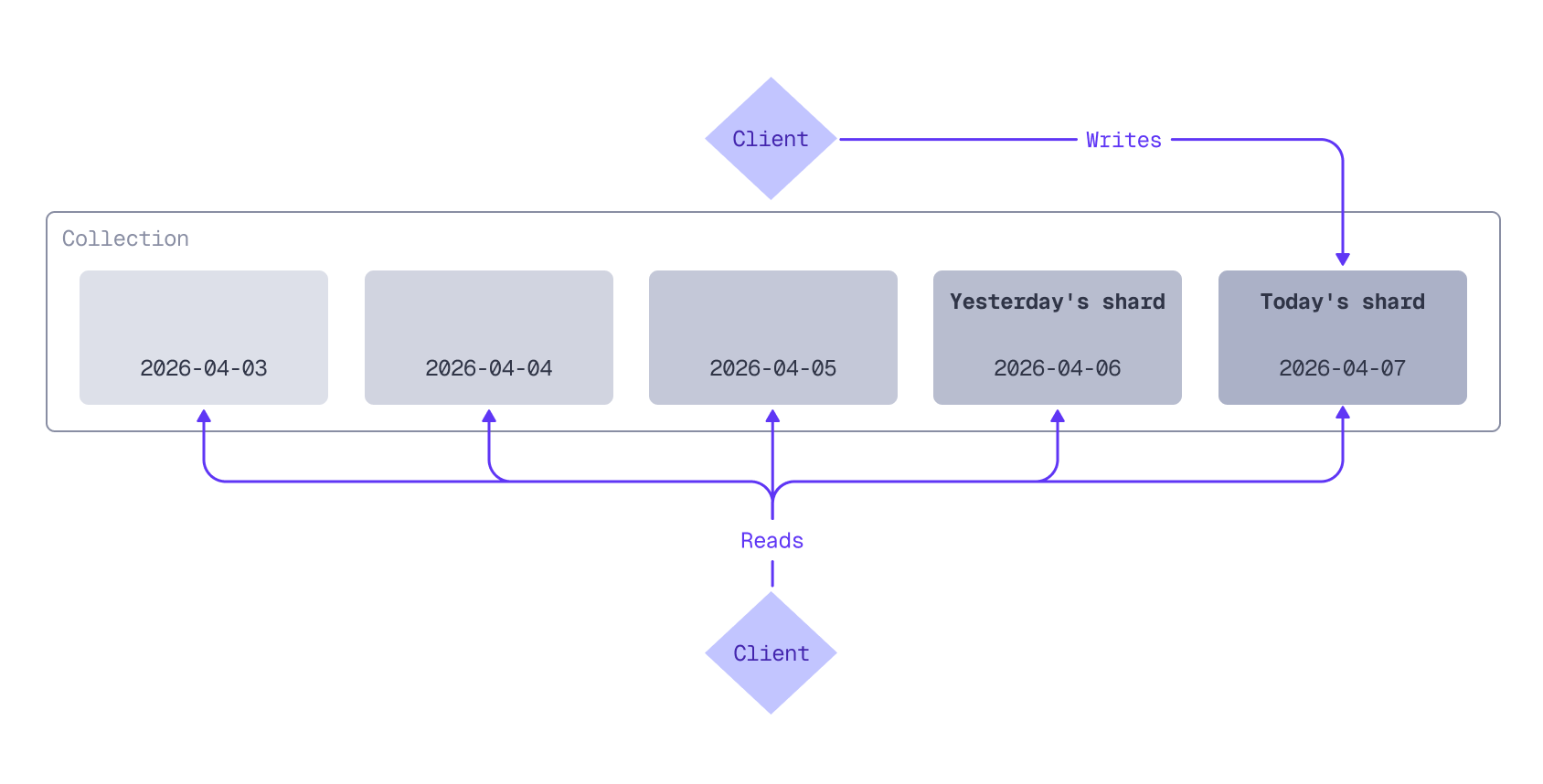
Depending on your data volume and retention needs, you could shard by hour, week, month, or any other time interval that suits your use case.
This tutorial guides you through implementing time-based sharding and covers:
- Creating a Qdrant collection with user-defined sharding
- Batch-ingesting historical data into the correct shards based on timestamps
- Assigning new data to the most recent shard
- Querying one or more shards
- Pruning older shards
The interval and the retention window are the two choices this tutorial makes for you. The Plan time-based shards prompt has an agent derive both from your own data and query pattern, and say when the approach does not fit.
Agent Prompt Plan time-based shards
Help me plan time-based sharding for my Qdrant collection. First, read https://skills.qdrant.tech/qdrant-scaling/scaling-data-volume/sliding-time-window/SKILL.md

Before choosing a shard interval or retention window, ask me what my data contains, how quickly it arrives, how far back queries typically reach, and how long I need to retain it. Treat daily shards and a seven-day window as an example, not a default.

Recommend an interval and retention window based on my answers, and explain why they fit. If a sliding time window would not suit my workload, for example, because queries routinely span the full history or older data must remain searchable, say so before proposing a configuration.

If it fits, show me how to derive shard keys from my timestamp field. Then lay out the job that creates new shards and removes expired ones, including what runs at each time boundary and in what order. Explain how to handle a point that arrives late when its shard has already been deleted.

Finally, explain which choices I can change later and which require recreating the collection.
Uses the
qdrant-scaling/scaling-data-volume/sliding-time-window
agent skill.
What are agent skills?
Install and Initialize the Qdrant Client
First, install the Qdrant client:
pip install qdrant-client
Next, initialize the client:
from qdrant_client import QdrantClient, models

client = QdrantClient(
    url=QDRANT_URL,
    api_key=QDRANT_API_KEY,
    cloud_inference=True
)
const client = new QdrantClient({
    url: QDRANT_URL,
    apiKey: QDRANT_API_KEY,
});
let client = Qdrant::from_url(QDRANT_URL)
    .api_key(QDRANT_API_KEY)
    .build()?;
QdrantClient client =
    new QdrantClient(
        QdrantGrpcClient.newBuilder(QDRANT_URL, 6334, true)
            .withApiKey(QDRANT_API_KEY)
            .build());
var client = new QdrantClient(
	host: QDRANT_URL,
	https: true,
	apiKey: QDRANT_API_KEY
);
client, err := qdrant.NewClient(&qdrant.Config{
	Host:   QDRANT_URL,
	APIKey: QDRANT_API_KEY,
	UseTLS: true,
})
This tutorial assumes you are using Qdrant Cloud Inference to generate vector embeddings. If you manage your own embedding infrastructure, you can apply the same principles, but you will need to adapt the code examples to use your embedding service.
Create Collection
Create a collection with user-defined sharding by setting the sharding method to custom.
from qdrant_client import models

collection_name = "my_collection"

if client.collection_exists(collection_name=collection_name):
    client.delete_collection(collection_name=collection_name)

client.create_collection(
    collection_name=collection_name,
    vectors_config={
        "dense_vector": models.VectorParams(
            size=384, distance=models.Distance.COSINE
        )
    },
    sharding_method=models.ShardingMethod.CUSTOM
)
const collectionName = "my_collection";

if (await client.collectionExists(collectionName)) {
    await client.deleteCollection(collectionName);
}

await client.createCollection(collectionName, {
    vectors: {
        dense_vector: {
            size: 384,
            distance: "Cosine",
        },
    },
    sharding_method: "custom",
});
let collection_name = "my_collection";

if client.collection_exists(collection_name).await? {
    client.delete_collection(collection_name).await?;
}

let mut vectors_config = VectorsConfigBuilder::default();
vectors_config.add_named_vector_params(
    "dense_vector",
    VectorParamsBuilder::new(384, Distance::Cosine),
);

client
    .create_collection(
        CreateCollectionBuilder::new(collection_name)
            .vectors_config(vectors_config)
            .sharding_method(ShardingMethod::Custom.into()),
    )
    .await?;
String collectionName = "my_collection";

if (client.collectionExistsAsync(collectionName).get()) {
    client.deleteCollectionAsync(collectionName).get();
}

client.createCollectionAsync(
    CreateCollection.newBuilder()
        .setCollectionName(collectionName)
        .setVectorsConfig(VectorsConfig.newBuilder().setParamsMap(
            VectorParamsMap.newBuilder().putAllMap(Map.of(
                "dense_vector",
                VectorParams.newBuilder()
                    .setSize(384)
                    .setDistance(Distance.Cosine)
                    .build()))))
        .setShardingMethod(ShardingMethod.Custom)
        .build()
).get();
string collectionName = "my_collection";

if (await client.CollectionExistsAsync(collectionName))
	await client.DeleteCollectionAsync(collectionName);

await client.CreateCollectionAsync(
	collectionName: collectionName,
	vectorsConfig: new VectorParamsMap
	{
		Map = {
			["dense_vector"] = new VectorParams { Size = 384, Distance = Distance.Cosine }
		}
	},
	shardingMethod: ShardingMethod.Custom
);
collectionName := "my_collection"

exists, err := client.CollectionExists(context.Background(), collectionName)
if exists {
	client.DeleteCollection(context.Background(), collectionName)
}

client.CreateCollection(context.Background(), &qdrant.CreateCollection{
	CollectionName: collectionName,
	VectorsConfig: qdrant.NewVectorsConfigMap(
		map[string]*qdrant.VectorParams{
			"dense_vector": {
				Size:     384,
				Distance: qdrant.Distance_Cosine,
			},
		},
	),
	ShardingMethod: qdrant.ShardingMethod_Custom.Enum(),
})
Custom shards can be accessed by their shard key. In this tutorial, the shard keys are the dates in YYYY-MM-DD format, extracted from the timestamp of each data point.
This collection will have a single shard for each shard key (a separate shard for each day of data). For very large datasets, you can improve write throughput by configuring a shard_number for the collection. shard_number defaults to 1. Set it to a higher value to create multiple shards per shard key to distribute the write load across multiple peers in the cluster. However, avoid creating too many shards, as each shard consumes resources and adds overhead, which can lead to performance degradation. Test what the optimal number of shards is for your dataset and cluster configuration.
Two things to note about collections that use user-defined sharding versus regular collections using auto sharding:
- For regular collections using auto sharding,
shard_numberdetermines the total number of shards for the collection. However, with user-defined sharding,shard_numberdetermines the number of shards per shard key: the total number of shards for a collection equals the number of shard keys (days) multiplied by theshard_number. - Collection-level configuration changes that you can apply to a regular collection (for example, HNSW parameters) can also be applied to a collection with user-defined sharding. These changes are applied retroactively to existing shards and to new shards created in the future.
Ingest Historical Data
Time series data often arrives in streams, with new data points continuously being added. Each data point may include a timestamp indicating when it was created. You can use this timestamp to determine which shard a data point belongs to. If your data does not have timestamps, you can use the current time.
This tutorial uses a sample dataset of social media posts with timestamps. Let’s assume today is April 7th, 2026. You’ll start by ingesting some historical data from this week (April 1-7). Here are a few sample rows from the dataset:
| datetime | text |
|---|---|
| 2026-04-06T09:04:28 | April sunshine through the office window makes everything better. |
| 2026-04-06T09:04:32 | Morning stretch, good coffee, clear intentions. Monday: sorted. |
| 2026-04-06T09:05:52 | Grateful for a productive first day of the week. |
Upload the dataset and store each day of data in its own shard:
from qdrant_client.http.models import PointStruct, Document
import uuid

csv_url = 'https://raw.githubusercontent.com/qdrant/examples/refs/heads/master/time-based-sharding/social-media-posts.csv'

# Retrieve a list of existing shard keys in the collection
existing_shard_keys = [
    key.key for key in client.list_shard_keys(collection_name=collection_name).shard_keys or []
]

dense_model = "sentence-transformers/all-MiniLM-L6-v2"
batch_size = 100
current_date = None
buffer: list[PointStruct] = []

for row in parse_csv(csv_url):
    shard_date = row['datetime'][:10]  # Extract YYYY-MM-DD

    if shard_date != current_date:
        # Flush buffer for the previous date before switching
        if buffer:
            client.upload_points(
                collection_name=collection_name,
                points=buffer,
                shard_key_selector=current_date,
            )
            buffer = []

        # Create shard for the new date if it doesn't exist yet
        if shard_date not in existing_shard_keys:
            client.create_shard_key(collection_name, shard_date)
            existing_shard_keys.append(shard_date)

        current_date = shard_date

    # Add point to buffer
    buffer.append(PointStruct(
        id=uuid.uuid4().hex,
        payload={"text": row['text'], "datetime": row['datetime']},
        vector={"dense_vector": Document(text=row["text"], model=dense_model)}
    ))

    # Flush batch if buffer size exceeds batch size
    if len(buffer) >= batch_size:
        client.upload_points(
            collection_name=collection_name,
            points=buffer,
            shard_key_selector=current_date,
        )
        buffer = []

# Flush remaining partial batch
if buffer:
    client.upload_points(
        collection_name=collection_name,
        points=buffer,
        shard_key_selector=current_date,
    )
const csvUrl = "https://raw.githubusercontent.com/qdrant/examples/refs/heads/master/time-based-sharding/social-media-posts.csv";

// Retrieve a list of existing shard keys in the collection
const shardKeysResult = await client.listShardKeys(collectionName);
const existingShardKeys = new Set((shardKeysResult.shard_keys ?? []).map((d) => String(d.key)));

const denseModel = "sentence-transformers/all-MiniLM-L6-v2";
const batchSize = 100;
let currentDate = "";
let buffer: Extract<Parameters<typeof client.upsert>[1], { points: unknown }>['points'] = [];

for await (const { text: postText, datetime } of parseCSV(csvUrl)) {
    const shardDate = datetime.slice(0, 10); // Extract YYYY-MM-DD

    if (shardDate !== currentDate) {
        // Flush buffer for the previous date before switching
        if (buffer.length > 0) {
            await client.upsert(collectionName, { points: buffer, shard_key: currentDate });
            buffer = [];
        }

        // Create shard for the new date if it doesn't exist yet
        if (!existingShardKeys.has(shardDate)) {
            await client.createShardKey(collectionName, { shard_key: shardDate });
            existingShardKeys.add(shardDate);
        }

        currentDate = shardDate;
    }

    // Add point to buffer
    buffer.push({
        id: crypto.randomUUID(),
        vector: { dense_vector: { text: postText, model: denseModel } },
        payload: { text: postText, datetime },
    });

    // Flush batch if buffer size exceeds batch size
    if (buffer.length >= batchSize) {
        await client.upsert(collectionName, { points: buffer, shard_key: currentDate });
        buffer = [];
    }
}

// Flush remaining partial batch
if (buffer.length > 0) {
    await client.upsert(collectionName, { points: buffer, shard_key: currentDate });
}
let csv_url = "https://raw.githubusercontent.com/qdrant/examples/refs/heads/master/time-based-sharding/social-media-posts.csv";

// Retrieve a list of existing shard keys in the collection
let response = client.list_shard_keys(collection_name).await?;
let mut existing_shard_keys: HashSet<String> = response
    .shard_keys
    .into_iter()
    .filter_map(|d| {
        d.key?.key.and_then(|k| match k {
            shard_key::Key::Keyword(s) => Some(s),
            _ => None,
        })
    })
    .collect();

let dense_model = "sentence-transformers/all-MiniLM-L6-v2";
let batch_size = 100;
let mut current_date = String::new();
let mut buffer: Vec<PointStruct> = Vec::new();

for row in parse_csv(csv_url)? {
    let row = row?;
    let text = row.text;
    let datetime = row.datetime;
    let shard_date = datetime[..10].to_string(); // Extract YYYY-MM-DD

    if shard_date != current_date {
        // Flush buffer for the previous date before switching
        if !buffer.is_empty() {
            client
                .upsert_points(
                    UpsertPointsBuilder::new(
                        collection_name,
                        std::mem::take(&mut buffer),
                    )
                    .shard_key_selector(current_date.clone()),
                )
                .await?;
        }

        // Create shard for the new date if it doesn't exist yet
        if !existing_shard_keys.contains(&shard_date) {
            client
                .create_shard_key(
                    CreateShardKeyRequestBuilder::new(collection_name).request(
                        CreateShardKeyBuilder::default().shard_key(shard_date.clone()),
                    ),
                )
                .await?;
            existing_shard_keys.insert(shard_date.clone());
        }

        current_date = shard_date;
    }

    // Add point to buffer
    buffer.push(PointStruct::new(
        uuid::Uuid::new_v4().to_string(),
        HashMap::from([(
            "dense_vector".to_string(),
            DocumentBuilder::new(&text, dense_model).build(),
        )]),
        [("text", text.into()), ("datetime", datetime.into())],
    ));

    // Flush batch if buffer size exceeds batch size
    if buffer.len() >= batch_size {
        client
            .upsert_points(
                UpsertPointsBuilder::new(collection_name, std::mem::take(&mut buffer))
                    .shard_key_selector(current_date.clone()),
            )
            .await?;
    }
}

// Flush remaining partial batch
if !buffer.is_empty() {
    client
        .upsert_points(
            UpsertPointsBuilder::new(collection_name, buffer)
                .shard_key_selector(current_date.clone()),
        )
        .await?;
}
String csvUrl = "https://raw.githubusercontent.com/qdrant/examples/refs/heads/master/time-based-sharding/social-media-posts.csv";

// Retrieve a list of existing shard keys in the collection
var shardKeyDescriptions = client.listShardKeysAsync(collectionName).get();
Set<String> existingShardKeys = new HashSet<>();
for (var desc : shardKeyDescriptions) {
    existingShardKeys.add(desc.getKey().getKeyword());
}

String denseModel = "sentence-transformers/all-MiniLM-L6-v2";
int batchSize = 100;
String currentDate = null;
List<PointStruct> buffer = new ArrayList<>();

try (var stream = parseCSV(csvUrl)) {
    for (var row : (Iterable<CsvRow>) stream::iterator) {
        String text = row.text;
        String datetime = row.datetime;
        String shardDate = datetime.substring(0, 10); // Extract YYYY-MM-DD

        if (!shardDate.equals(currentDate)) {
            // Flush buffer for the previous date before switching
            if (!buffer.isEmpty()) {
                client.upsertAsync(
                    UpsertPoints.newBuilder()
                        .setCollectionName(collectionName)
                        .addAllPoints(buffer)
                        .setShardKeySelector(shardKeySelector(currentDate))
                        .build()
                ).get();
                buffer.clear();
            }

            // Create shard for the new date if it doesn't exist yet
            if (!existingShardKeys.contains(shardDate)) {
                client.createShardKeyAsync(
                    CreateShardKeyRequest.newBuilder()
                        .setCollectionName(collectionName)
                        .setRequest(CreateShardKey.newBuilder()
                            .setShardKey(shardKey(shardDate))
                            .build())
                        .build()
                ).get();
                existingShardKeys.add(shardDate);
            }

            currentDate = shardDate;
        }

        // Add point to buffer
        buffer.add(
            PointStruct.newBuilder()
                .setId(id(UUID.randomUUID()))
                .setVectors(namedVectors(Map.of(
                    "dense_vector",
                    vector(Document.newBuilder()
                        .setText(text)
                        .setModel(denseModel)
                        .build()))))
                .putAllPayload(Map.of("text", value(text), "datetime", value(datetime)))
                .build());

        // Flush batch if buffer size exceeds batch size
        if (buffer.size() >= batchSize) {
            client.upsertAsync(
                UpsertPoints.newBuilder()
                    .setCollectionName(collectionName)
                    .addAllPoints(buffer)
                    .setShardKeySelector(shardKeySelector(currentDate))
                    .build()
            ).get();
            buffer.clear();
        }
    }
}

// Flush remaining partial batch
if (!buffer.isEmpty()) {
    client.upsertAsync(
        UpsertPoints.newBuilder()
            .setCollectionName(collectionName)
            .addAllPoints(buffer)
            .setShardKeySelector(shardKeySelector(currentDate))
            .build()
    ).get();
}
string csvUrl = "https://raw.githubusercontent.com/qdrant/examples/refs/heads/master/time-based-sharding/social-media-posts.csv";

// Retrieve a list of existing shard keys in the collection
var existingShardKeys = (await client.ListShardKeysAsync(collectionName))
	.Select(sk => sk.Key.Keyword)
	.ToHashSet();

string denseModel = "sentence-transformers/all-MiniLM-L6-v2";
int batchSize = 100;
string? currentDate = null;
var buffer = new List<PointStruct>();

await foreach (var (text, datetime) in ParseCsv(csvUrl))
{
	string shardDate = datetime[..10]; // Extract YYYY-MM-DD

	if (shardDate != currentDate)
	{
		// Flush buffer for the previous date before switching
		if (buffer.Count > 0)
		{
			await client.UpsertAsync(
				collectionName: collectionName,
				points: buffer,
				shardKeySelector: new ShardKeySelector
				{
					ShardKeys = { new List<ShardKey> { currentDate! } }
				}
			);
			buffer.Clear();
		}

		// Create shard for the new date if it doesn't exist yet
		if (!existingShardKeys.Contains(shardDate))
		{
			await client.CreateShardKeyAsync(
				collectionName,
				new CreateShardKey { ShardKey = new ShardKey { Keyword = shardDate } }
			);
			existingShardKeys.Add(shardDate);
		}

		currentDate = shardDate;
	}

	// Add point to buffer
	buffer.Add(new PointStruct
	{
		Id = Guid.NewGuid(),
		Vectors = new Dictionary<string, Vector>
		{
			["dense_vector"] = new Document { Text = text, Model = denseModel }
		},
		Payload = { ["text"] = text, ["datetime"] = datetime }
	});

	// Flush batch if buffer size exceeds batch size
	if (buffer.Count >= batchSize)
	{
		await client.UpsertAsync(
			collectionName: collectionName,
			points: buffer,
			shardKeySelector: new ShardKeySelector
			{
				ShardKeys = { new List<ShardKey> { currentDate! } }
			}
		);
		buffer.Clear();
	}
}

// Flush remaining partial batch
if (buffer.Count > 0)
{
	await client.UpsertAsync(
		collectionName: collectionName,
		points: buffer,
		shardKeySelector: new ShardKeySelector
		{
			ShardKeys = { new List<ShardKey> { currentDate! } }
		}
	);
}
csvUrl := "https://raw.githubusercontent.com/qdrant/examples/refs/heads/master/time-based-sharding/social-media-posts.csv"

shardKeyDescriptions, err := client.ListShardKeys(context.Background(), collectionName)

// Retrieve a list of existing shard keys in the collection
existingShardKeys := make(map[string]bool)
for _, desc := range shardKeyDescriptions {
	existingShardKeys[desc.Key.GetKeyword()] = true
}

denseModel := "sentence-transformers/all-MiniLM-L6-v2"
batchSize := 100
var currentDate string
var buffer []*qdrant.PointStruct

err = parseCSV(csvUrl, func(row CSVRow) {
	text := row.Text
	datetime := row.Datetime
	shardDate := datetime[:10] // Extract YYYY-MM-DD

	if shardDate != currentDate {
		// Flush buffer for the previous date before switching
		if len(buffer) > 0 {
			client.Upsert(context.Background(), &qdrant.UpsertPoints{
				CollectionName: collectionName,
				Points:         buffer,
				ShardKeySelector: &qdrant.ShardKeySelector{
					ShardKeys: []*qdrant.ShardKey{qdrant.NewShardKey(currentDate)},
				},
			})
			buffer = nil
		}

		// Create shard for the new date if it doesn't exist yet
		if !existingShardKeys[shardDate] {
			client.CreateShardKey(context.Background(), collectionName, &qdrant.CreateShardKey{
				ShardKey: qdrant.NewShardKey(shardDate),
			})
			existingShardKeys[shardDate] = true
		}

		currentDate = shardDate
	}

	// Add point to buffer
	buffer = append(buffer, &qdrant.PointStruct{
		Id: qdrant.NewID(uuid.New().String()),
		Vectors: qdrant.NewVectorsMap(map[string]*qdrant.Vector{
			"dense_vector": qdrant.NewVectorDocument(&qdrant.Document{
				Text:  text,
				Model: denseModel,
			}),
		}),
		Payload: qdrant.NewValueMap(map[string]any{
			"text":     text,
			"datetime": datetime,
		}),
	})

	// Flush batch if buffer size exceeds batch size
	if len(buffer) >= batchSize {
		client.Upsert(context.Background(), &qdrant.UpsertPoints{
			CollectionName: collectionName,
			Points:         buffer,
			ShardKeySelector: &qdrant.ShardKeySelector{
				ShardKeys: []*qdrant.ShardKey{qdrant.NewShardKey(currentDate)},
			},
		})
		buffer = nil
	}
})

// Flush remaining partial batch
if len(buffer) > 0 {
	client.Upsert(context.Background(), &qdrant.UpsertPoints{
		CollectionName: collectionName,
		Points:         buffer,
		ShardKeySelector: &qdrant.ShardKeySelector{
			ShardKeys: []*qdrant.ShardKey{qdrant.NewShardKey(currentDate)},
		},
	})
}
Let’s break down the code:
- First, a list of existing shard keys in the collection is retrieved. There should be none because you just created the collection, but in production, this ensures you take into account any existing data.
- Next, a CSV file is streamed from a URL using a helper function to parse the CSV.
Details
import csv
  import urllib.request

  def parse_csv(url):
      with urllib.request.urlopen(url) as response:
          reader = csv.DictReader(line.decode('utf-8') for line in response)
          yield from reader
function parseCsvLine(line: string): string[] { const fields: string[] = []; let i = 0; while (i < line.length) { if (line[i] === '"') { i++; let field = ""; while (i < line.length) { if (line[i] === '"' && line[i + 1] === '"') { field += '"'; i += 2; } else if (line[i] === '"') { i++; break; } else { field += line[i++]; } } fields.push(field); if (line[i] === ",") i++; } else { const start = i; while (i < line.length && line[i] !== ",") i++; fields.push(line.slice(start, i)); if (i < line.length) i++; } } return fields; } async function* parseCSV(url: string): AsyncGenerator<{ text: string; datetime: string }> { const response = await fetch(url); const reader = response.body!.getReader(); const decoder = new TextDecoder(); let remainder = ""; let headers: string[] | null = null; let textIdx = -1; let datetimeIdx = -1; while (true) { const { done, value } = await reader.read(); const chunk = done ? "" : decoder.decode(value, { stream: true }); const lines = (remainder + chunk).split("\n"); remainder = done ? "" : lines.pop()!; for (const line of lines) { if (!line.trim()) continue; if (headers === null) { headers = line.split(","); textIdx = headers.indexOf("text"); datetimeIdx = headers.indexOf("datetime"); continue; } const fields = parseCsvLine(line); yield { text: fields[textIdx], datetime: fields[datetimeIdx] }; } if (done) break; } }struct CsvRow { text: String, datetime: String, } fn parse_csv(url: &str) -> anyhow::Result<impl Iterator<Item = anyhow::Result<CsvRow>>> { let reader = ureq::get(url).call()?.into_body().into_reader(); let mut rdr = csv::Reader::from_reader(reader); let headers = rdr.headers()?.clone(); let text_idx = headers.iter().position(|h| h == "text").unwrap(); let datetime_idx = headers.iter().position(|h| h == "datetime").unwrap(); let iter = rdr.into_records().map(move |result| { let record = result?; Ok(CsvRow { text: record[text_idx].to_string(), datetime: record[datetime_idx].to_string(), }) }); Ok(iter) }static class CsvRow { final String text; final String datetime; CsvRow(String text, String datetime) { this.text = text; this.datetime = datetime; } } static Stream<CsvRow> parseCSV(String url) throws Exception { Function<String, List<String>> parseCsvLine = line -> { List<String> fields = new ArrayList<>(); boolean inQuotes = false; var sb = new StringBuilder(); for (char c : line.toCharArray()) { if (c == '"') { inQuotes = !inQuotes; } else if (c == ',' && !inQuotes) { fields.add(sb.toString()); sb.setLength(0); } else { sb.append(c); } } fields.add(sb.toString()); return fields; }; var reader = new BufferedReader(new InputStreamReader(new URL(url).openStream())); String headerLine = reader.readLine(); List<String> headers = List.of(headerLine.split(",")); int textIdx = headers.indexOf("text"); int datetimeIdx = headers.indexOf("datetime"); return reader.lines() .map(line -> { List<String> fields = parseCsvLine.apply(line); return new CsvRow(fields.get(textIdx), fields.get(datetimeIdx)); }) .onClose(() -> { try { reader.close(); } catch (Exception ignored) {} }); }async IAsyncEnumerable<(string text, string datetime)> ParseCsv(string url) { using var httpClient = new HttpClient(); using var stream = await httpClient.GetStreamAsync(url); using var parser = new TextFieldParser(new StreamReader(stream)); parser.TextFieldType = Microsoft.VisualBasic.FileIO.FieldType.Delimited; parser.SetDelimiters(","); string[]? headers = parser.ReadFields(); int textIdx = Array.IndexOf(headers!, "text"); int datetimeIdx = Array.IndexOf(headers!, "datetime"); while (!parser.EndOfData) { var fields = parser.ReadFields()!; yield return (fields[textIdx], fields[datetimeIdx]); } }type CSVRow struct { Text string Datetime string } func parseCSV(url string, fn func(CSVRow)) error { resp, err := http.Get(url) if err != nil { return err } defer resp.Body.Close() csvReader := csv.NewReader(resp.Body) headers, err := csvReader.Read() if err != nil { return err } textIdx, datetimeIdx := -1, -1 for i, h := range headers { switch h { case "text": textIdx = i case "datetime": datetimeIdx = i } } for { row, err := csvReader.Read() if err == io.EOF { break } if err != nil { return err } fn(CSVRow{Text: row[textIdx], Datetime: row[datetimeIdx]}) } return nil } - The CSV file is streamed row by row, buffering points in batches of 100 for efficient uploading. The optimal batch size depends on your data and cluster, so you may want to experiment with different sizes for best performance.
- The date (
YYYY-MM-DD) is extracted from each row’s datetime field. This date is used as the shard key to route the data to the correct shard. - A new shard is created for each new date encountered if it doesn’t already exist.
- The buffer is flushed to the previous date’s shard whenever the date changes mid-stream, ensuring posts don’t get written to the wrong shard.
- Data is written, where each point gets:
- A random UUID as the point ID
- The post
textanddatetimeas the payload - A dense vector embedding generated from the post text using
sentence-transformers/all-MiniLM-L6-v2
- Each full batch of 100 points is uploaded to Qdrant, targeting the correct date-based shard via the shard key selector parameter.
- Any remaining points are uploaded in a partial final batch after the loop ends.
Query the Data
Query Today’s Data
Now you can run a semantic query on the posts. Setting the shard key selector to 2026-04-07 (assuming today is April 7th, 2026) limits the query to the shard that stores today’s data:
query_text = "coffee"

resp = client.query_points(
    collection_name=collection_name,
    query=Document(text=query_text, model=dense_model),
    using="dense_vector",
    limit=5,
    shard_key_selector="2026-04-07"
)
print(resp)
const queryText = "coffee";

const singleShardResult = await client.query(collectionName, {
    query: { text: queryText, model: denseModel },
    using: "dense_vector",
    limit: 5,
    shard_key: "2026-04-07",
});

for (const hit of singleShardResult.points) {
    console.log(hit);
}
let query_text = "coffee";

let result = client
    .query(
        QueryPointsBuilder::new(collection_name)
            .query(Query::new_nearest(Document::new(query_text, dense_model)))
            .using("dense_vector")
            .limit(5)
            .shard_key_selector("2026-04-07".to_string()),
    )
    .await?;

for hit in result.result {
    println!("{:?}", hit);
}
String queryText = "coffee";

var result = client.queryAsync(
    QueryPoints.newBuilder()
        .setCollectionName(collectionName)
        .setQuery(nearest(Document.newBuilder().setText(queryText).setModel(denseModel).build()))
        .setUsing("dense_vector")
        .setLimit(5)
        .setShardKeySelector(shardKeySelector("2026-04-07"))
        .build()
).get();

for (var hit : result) {
    System.out.println(hit);
}
string queryText = "coffee";

var result = await client.QueryAsync(
	collectionName: collectionName,
	query: new Document { Text = queryText, Model = denseModel },
	usingVector: "dense_vector",
	limit: 5,
	shardKeySelector: new ShardKeySelector
	{
		ShardKeys = { new List<ShardKey> { "2026-04-07" } }
	}
);

foreach (var hit in result)
	Console.WriteLine(hit);
queryText := "coffee"

result, err := client.Query(context.Background(), &qdrant.QueryPoints{
	CollectionName: collectionName,
	Query:          qdrant.NewQueryDocument(&qdrant.Document{Text: queryText, Model: denseModel}),
	Using:          qdrant.PtrOf("dense_vector"),
	Limit:          qdrant.PtrOf(uint64(5)),
	ShardKeySelector: &qdrant.ShardKeySelector{
		ShardKeys: []*qdrant.ShardKey{qdrant.NewShardKey("2026-04-07")},
	},
})

for _, hit := range result {
	fmt.Println(hit)
}
Query Multiple Days of Data
To query multiple shards, set the shard key selector to a list of shard keys. For example, to query the last 2 days of data (April 6-7):
resp = client.query_points(
    collection_name=collection_name,
    query=Document(text=query_text, model=dense_model),
    using="dense_vector",
    limit=5,
    shard_key_selector=["2026-04-06","2026-04-07"]
)
print(resp)
const multiShardResult = await client.query(collectionName, {
    query: { text: queryText, model: denseModel },
    using: "dense_vector",
    limit: 5,
    shard_key: ["2026-04-06", "2026-04-07"],
});

for (const hit of multiShardResult.points) {
    console.log(hit);
}
let result = client
    .query(
        QueryPointsBuilder::new(collection_name)
            .query(Query::new_nearest(Document::new(query_text, dense_model)))
            .using("dense_vector")
            .limit(5)
            .shard_key_selector(ShardKeySelector {
                shard_keys: vec![
                    "2026-04-06".to_string().into(),
                    "2026-04-07".to_string().into(),
                ],
                fallback: None,
            }),
    )
    .await?;

for hit in result.result {
    println!("{:?}", hit);
}
result = client.queryAsync(
    QueryPoints.newBuilder()
        .setCollectionName(collectionName)
        .setQuery(nearest(Document.newBuilder().setText(queryText).setModel(denseModel).build()))
        .setUsing("dense_vector")
        .setLimit(5)
        .setShardKeySelector(ShardKeySelector.newBuilder()
            .addShardKeys(shardKey("2026-04-06"))
            .addShardKeys(shardKey("2026-04-07"))
            .build())
        .build()
).get();

for (var hit : result) {
    System.out.println(hit);
}
result = await client.QueryAsync(
	collectionName: collectionName,
	query: new Document { Text = queryText, Model = denseModel },
	usingVector: "dense_vector",
	limit: 5,
	shardKeySelector: new ShardKeySelector
	{
		ShardKeys = { new List<ShardKey> { "2026-04-06", "2026-04-07" } }
	}
);

foreach (var hit in result)
	Console.WriteLine(hit);
result, err = client.Query(context.Background(), &qdrant.QueryPoints{
	CollectionName: collectionName,
	Query:          qdrant.NewQueryDocument(&qdrant.Document{Text: queryText, Model: denseModel}),
	Using:          qdrant.PtrOf("dense_vector"),
	Limit:          qdrant.PtrOf(uint64(5)),
	ShardKeySelector: &qdrant.ShardKeySelector{
		ShardKeys: []*qdrant.ShardKey{
			qdrant.NewShardKey("2026-04-06"),
			qdrant.NewShardKey("2026-04-07"),
		},
	},
})

for _, hit := range result {
	fmt.Println(hit)
}
Query the Full Dataset
To query the entire dataset (all shards), omit the shard key selector parameter:
resp = client.query_points(
    collection_name=collection_name,
    query=Document(text=query_text, model=dense_model),
    using="dense_vector",
    limit=5,
)
print(resp)
const allShardsResult = await client.query(collectionName, {
    query: { text: queryText, model: denseModel },
    using: "dense_vector",
    limit: 5,
});

for (const hit of allShardsResult.points) {
    console.log(hit);
}
let result = client
    .query(
        QueryPointsBuilder::new(collection_name)
            .query(Query::new_nearest(Document::new(query_text, dense_model)))
            .using("dense_vector")
            .limit(5),
    )
    .await?;

for hit in result.result {
    println!("{:?}", hit);
}
result = client.queryAsync(
    QueryPoints.newBuilder()
        .setCollectionName(collectionName)
        .setQuery(nearest(Document.newBuilder().setText(queryText).setModel(denseModel).build()))
        .setUsing("dense_vector")
        .setLimit(5)
        .build()
).get();

for (var hit : result) {
    System.out.println(hit);
}
result = await client.QueryAsync(
	collectionName: collectionName,
	query: new Document { Text = queryText, Model = denseModel },
	usingVector: "dense_vector",
	limit: 5
);

foreach (var hit in result)
	Console.WriteLine(hit);
result, err = client.Query(context.Background(), &qdrant.QueryPoints{
	CollectionName: collectionName,
	Query:          qdrant.NewQueryDocument(&qdrant.Document{Text: queryText, Model: denseModel}),
	Using:          qdrant.PtrOf("dense_vector"),
	Limit:          qdrant.PtrOf(uint64(5)),
})

for _, hit := range result {
	fmt.Println(hit)
}
Pruning Shards
Every night at midnight, create a new shard for the new data that will be ingested that day. If you only query the last 7 days of data, you can also delete the oldest shard. You can automate this with a cron job. The example sets today to 2026-04-08 to match the sample data. In a scheduled job, use date.today().isoformat() instead.
from datetime import date, timedelta

today = "2026-04-08"
oldest_shard_key = (date.fromisoformat(today) - timedelta(days=7)).isoformat()

client.create_shard_key(collection_name, today)
client.delete_shard_key(collection_name, oldest_shard_key)
const today = "2026-04-08";
const oldestDate = new Date(today);
oldestDate.setDate(oldestDate.getDate() - 7);
const oldestShardKey = oldestDate.toISOString().slice(0, 10);

await client.createShardKey(collectionName, { shard_key: today });
await client.deleteShardKey(collectionName, { shard_key: oldestShardKey });
let today = "2026-04-08";
let oldest_shard_key = (NaiveDate::parse_from_str(today, "%Y-%m-%d")?
    - chrono::Duration::days(7))
.to_string();

client
    .create_shard_key(
        CreateShardKeyRequestBuilder::new(collection_name)
            .request(CreateShardKeyBuilder::default().shard_key(today.to_string())),
    )
    .await?;

client
    .delete_shard_key(
        DeleteShardKeyRequestBuilder::new(collection_name)
            .key(shard_key::Key::Keyword(oldest_shard_key)),
    )
    .await?;
String today = "2026-04-08";
String oldestShardKey = LocalDate.parse(today).minusDays(7).toString();

client.createShardKeyAsync(
    CreateShardKeyRequest.newBuilder()
        .setCollectionName(collectionName)
        .setRequest(CreateShardKey.newBuilder()
            .setShardKey(shardKey(today))
            .build())
        .build()
).get();

client.deleteShardKeyAsync(
    DeleteShardKeyRequest.newBuilder()
        .setCollectionName(collectionName)
        .setRequest(DeleteShardKey.newBuilder()
            .setShardKey(shardKey(oldestShardKey))
            .build())
        .build()
).get();
string today = "2026-04-08";
string oldestShardKey = DateOnly.ParseExact(today, "yyyy-MM-dd")
	.AddDays(-7)
	.ToString("yyyy-MM-dd");

await client.CreateShardKeyAsync(
	collectionName,
	new CreateShardKey { ShardKey = new ShardKey { Keyword = today } }
);
await client.DeleteShardKeyAsync(
	collectionName,
	new DeleteShardKey { ShardKey = new ShardKey { Keyword = oldestShardKey } }
);
today := "2026-04-08"
t, _ := time.Parse("2006-01-02", today)
oldestShardKey := t.AddDate(0, 0, -7).Format("2006-01-02")

client.CreateShardKey(context.Background(), collectionName, &qdrant.CreateShardKey{
	ShardKey: qdrant.NewShardKey(today),
})
client.DeleteShardKey(context.Background(), collectionName, &qdrant.DeleteShardKey{
	ShardKey: qdrant.NewShardKey(oldestShardKey),
})
Ingest New Data
When ingesting new data, set the shard_key_selector to today’s date, using the today value defined in the pruning step, so the data goes to the correct shard:
client.upsert(
    collection_name=collection_name,
    points=[PointStruct(
        id=uuid.uuid4().hex,
        payload={"text": "The best way to start a Wednesday is with a cup of coffee", "datetime": "2026-04-08T07:57:47"},
        vector={
            "dense_vector": Document(text="The best way to start a Wednesday is with a cup of coffee", model=dense_model)
        })],
    shard_key_selector=today
)
await client.upsert(collectionName, {
    points: [
        {
            id: crypto.randomUUID(),
            vector: {
                dense_vector: {
                    text: "The best way to start a Wednesday is with a cup of coffee",
                    model: denseModel,
                },
            },
            payload: {
                text: "The best way to start a Wednesday is with a cup of coffee",
                datetime: "2026-04-08T07:57:47",
            },
        },
    ],
    shard_key: today,
});
client
    .upsert_points(
        UpsertPointsBuilder::new(
            collection_name,
            vec![PointStruct::new(
                uuid::Uuid::new_v4().to_string(),
                HashMap::from([(
                    "dense_vector".to_string(),
                    DocumentBuilder::new(
                        "The best way to start a Wednesday is with a cup of coffee",
                        dense_model,
                    )
                    .build(),
                )]),
                [
                    ("text", "The best way to start a Wednesday is with a cup of coffee".into()),
                    ("datetime", "2026-04-08T07:57:47".into()),
                ],
            )],
        )
        .shard_key_selector(today.to_string()),
    )
    .await?;
client.upsertAsync(
    UpsertPoints.newBuilder()
        .setCollectionName(collectionName)
        .addAllPoints(List.of(
            PointStruct.newBuilder()
                .setId(id(UUID.randomUUID()))
                .setVectors(namedVectors(Map.of(
                    "dense_vector",
                    vector(Document.newBuilder()
                        .setText("The best way to start a Wednesday is with a cup of coffee")
                        .setModel(denseModel)
                        .build()))))
                .putAllPayload(Map.of(
                    "text", value("The best way to start a Wednesday is with a cup of coffee"),
                    "datetime", value("2026-04-08T07:57:47")))
                .build()))
        .setShardKeySelector(shardKeySelector(today))
        .build()
).get();
await client.UpsertAsync(
	collectionName: collectionName,
	points: new List<PointStruct>
	{
		new()
		{
			Id = Guid.NewGuid(),
			Vectors = new Dictionary<string, Vector>
			{
				["dense_vector"] = new Document
				{
					Text = "The best way to start a Wednesday is with a cup of coffee",
					Model = denseModel
				}
			},
			Payload =
			{
				["text"] = "The best way to start a Wednesday is with a cup of coffee",
				["datetime"] = "2026-04-08T07:57:47"
			}
		}
	},
	shardKeySelector: new ShardKeySelector
	{
		ShardKeys = { new List<ShardKey> { today } }
	}
);
client.Upsert(context.Background(), &qdrant.UpsertPoints{
	CollectionName: collectionName,
	Points: []*qdrant.PointStruct{
		{
			Id: qdrant.NewID(uuid.New().String()),
			Vectors: qdrant.NewVectorsMap(map[string]*qdrant.Vector{
				"dense_vector": qdrant.NewVectorDocument(&qdrant.Document{
					Text:  "The best way to start a Wednesday is with a cup of coffee",
					Model: denseModel,
				}),
			}),
			Payload: qdrant.NewValueMap(map[string]any{
				"text":     "The best way to start a Wednesday is with a cup of coffee",
				"datetime": "2026-04-08T07:57:47",
			}),
		},
	},
	ShardKeySelector: &qdrant.ShardKeySelector{
		ShardKeys: []*qdrant.ShardKey{qdrant.NewShardKey(today)},
	},
})
Conclusion
Time-based sharding is a powerful technique for managing large, time-series datasets in Qdrant. By routing data to different shards based on timestamps, you can efficiently store and query recent data while easily pruning older data without impacting performance. This approach is ideal for use cases like social media analysis, where data relevance decreases over time.
 Ready to try Qdrant?