- Products
- Solutions
- Developers
- Resources
- Company


Are your semantic search needs outgrowing Elastic and OpenSearch?
We can help.
Qdrant is a Rust-native engine designed for vector + filter search from day one, so you get predictable p99 performance and simpler production ops. No GC pauses, no workaround-heavy architecture.
Why Teams Replace Legacy Tools With Qdrant
Most teams find that the ongoing cost of Elastic (or other legacy tools) is hard to justify. It's expensive, hard to scale, and often requires specialized DevOps knowledge to manage.
Teams choose Qdrant because it allows them to build more performant vector search with less cost and complexity. You can leverage the same team you use for Postgres and easily migrate without rebuilding.

Using Qdrant, Sprinklr achieved 90% faster write time, 80% faster latency, 2.5x higher RPS than with Elastic.
Worried you'll collapse under real production load?
Qdrant is the AI retrieval engine built to handle dense, hybrid, and AI-native workloads at a size and performance that legacy systems were never built for.
No JVM garbage-collection pauses, no 3 a.m. reindex job.
Qdrant Can Optimize

Latency
Build lightning fast, massive AI applications on our Rust powered, native vector search engine.

Ingestion Speed
Qdrant ingests millions of vectors/minute while staying queryable.

Memory Provisioning
Stop over provisioning RAM to avoid failed index merges. Using Rust, Qdrant gives you more control over memory.

Scaling
Continue to meet your search KPIs at scale for speed, accuracy and cost with our vector-first features (e.g. native multi-vector).
Check Out Our Most Powerful Features


Ready to Build Vector Search the Right Way?
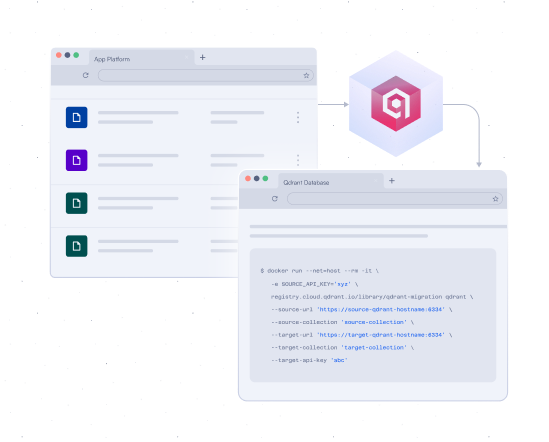
Move Beyond Elastic Without Rebuilding
Seamlessly Bring Your Data to Qdrant with our Migration Tool.
Migrating from Elastic's Lucene-based stack doesn't have to mean starting over. Our Migration Tool lets you stream your existing vector data directly into Qdrant, live, fast, and with zero downtime. It works even while data is being inserted, supports reconfiguration, and eliminates the headaches of reindexing or overprovisioning.
Modernize your retrieval layer in hours, not weeks.
Migrate NowWe'll Help You Benchmark
If you have a production use case, run a side-by-side benchmark on your own index to measure latency, RAM footprint, and throughput before you decide.
Our team of Solution Architects will help you test feasibility, latency, and cost.
No strings attached, no commitment. Performance that speaks for itself.
Learn How To Use Top Features with
Hands-On Lessons



Out of the Box Hybrid Search
Meet every searcher's needs with hybrid search in Qdrant. Combine dense and sparse vectors, apply Reciprocal Rank Fusion (RRF), and build complex multi-stage pipelines, all in a single call with the Universal Query API.


Multivector Mastery
Qdrant supports token-level precision with multivector fields for ColBERT-style late interaction. Compare query and document tokens via MaxSim scoring for sharper relevance, ideal for complex text and visual documents with ColPali.
Build with Qdrant Cloud
Spin up a managed cluster in minutes, optimized for vector-heavy, real-time AI workloads. No more overprovisioning. No more reindexing. No more latency surprises.
Try Now